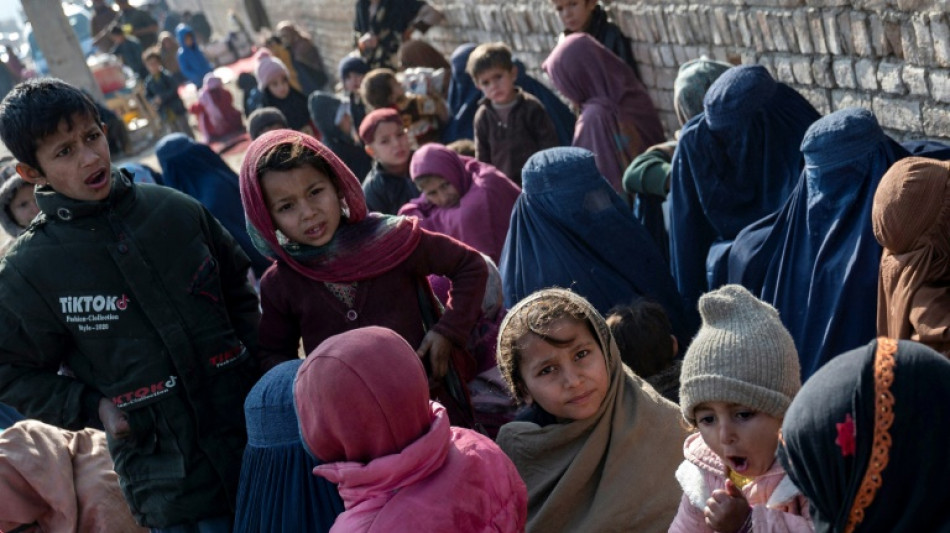
Millions of Afghans go hungry as winter cold bites / Photo: Wakil KOHSAR - AFP

 Expanded World Cup; same old story as Europe dominates quarter-finals

 Morocco's Saibari out of France World Cup quarter-final

 Trump orders new strikes on Iran over attacks on shipping in Hormuz

 PSG's Lee set to join Atletico Madrid

 Iran plays with fire, but calculates Trump will hold back

 Oil surges, stocks slide as Trump says Iran ceasefire over
 Meta to build $9 billion data center in western Canada

 Rogers backs Kane to outshine Haaland in World Cup showdown

 Some US Fed officials considered June rate hike on war fallout

 UN launches appeal for nearly $300 mn in Venezuela quake relief

 US to remove Syria from terror blacklist, in new boost to Sharaa

 Court rejects Trump request to restore his name to Kennedy Center

 MLB pitching great Verlander to retire after 2026 season

 Artificial cloud brightening could tame El Nino, but with risks: study

 Shocked and shaken, Venezuela quake survivors get psychological help

 France, Morocco kick off blockbuster World Cup quarter-finals

 Amorim hails 'ambitious' AC Milan, promises to learn Italian

 Cancer survivor Traeen takes the long road to Tour yellow

 Easing Russian Olympic restrictions 'terrible', says Wimbledon star Kostyuk
 'Unbelievable' Kooij wins Tour de France 5th stage in chaotic sprint finish

 Britain's Fery to face Zverev in Wimbledon semi-finals

 Zverev sees off Fritz to make first Wimbledon semi-final

 Barcelona sets new heat record at 40.7C: weather agencies

 'The Pitt,' 'Hacks' lead Emmy nominations

 France lose appeal against Olise booking at World Cup

Khurma had to borrow her neighbour's shoes to walk to Pul-e Alam city to collect a cash handout being given to the growing number of vulnerable Afghans who are struggling to survive the winter.
The 45-year-old widow waited in her threadbare blue burqa to receive 3,200 Afghanis ($45) from the UN World Food Programme (WFP) in the eastern Afghan city, where temperatures can drop well below freezing.
"We are desperate," the mother-of-six told AFP. "When we can't find any bread, we go to bed on an empty stomach."
She is one of millions facing months of hunger and cold, with natural disasters and displacement putting more Afghans at risk even as funding to one of the world's poorest countries -- wracked by decades of war -- has plummeted.
"Things were already quite catastrophic" in Afghanistan, said Caroline Gluck, spokesperson for the UN refugee agency, UNHCR. "But as winter starts we have two massive emergencies."
Thousands of people are still sleeping in tents in Herat province after successive earthquakes in October destroyed or rendered uninhabitable 31,000 homes.
And around half a million Afghans fleeing deportation from Pakistan have returned in recent months to a country where unemployment is rife, "at the worst possible time of the year", Gluck said.
Rabbani, 32, is one of them.
As a refugee, he is entitled to WFP aid: 50 kilograms (110 pounds) of flour, six kilograms of red beans, five litres of oil and 450 grams of salt.
But, "there is no work here", he said.
When freezing temperatures set in, his family of seven abandoned the tent they had occupied since crossing from Pakistan for a shack.
"When there is nothing left to eat, death is better than begging."
- Food emergency -
Shakar Gul, 67, had just received the first of six monthly payments of 3,200 Afghanis from the WFP.
"If we adults don't have enough to eat for several days, that's okay... but we don't let our children die of hunger," she said.
With the money she will be able to buy household essentials -- but only enough for 15 days.
This year, there is less assistance, due in part to a spike in humanitarian emergencies around the world and donor fatigue.
"Excluded people still come here and wait, especially women," said Baryalai Hakimi, director of the WFP's Pul-e Alam centre. "They are upset. We explain to them that the people who get help are more vulnerable than they are."
Such is the case for Bibi Raihana. Aged 40, she has eight children, a husband in prison, health problems and "not a single Afghani".
Her eyes were wet with tears behind the mesh of her burqa.
"My name wasn't on the lists. They didn't give me anything," she said.
This winter, 15.8 million Afghans need assistance, with 2.8 million at an emergency level of food insecurity, said Philippe Kropf, spokesperson for WFP, which provides 90 percent of food aid in Afghanistan.
Funding shortages have forced WFP to tighten the criteria for aid handouts, with just six million people eligible for emergency assistance in food, cash or vouchers, Kropf added.
"It leaves a gap of 10 million people."
Once flush with humanitarian aid following the US-led invasion of the country, funding to Afghanistan has plummeted since the Taliban returned to power in mid-2021, in part over the many restrictions imposed on women.
Today, approximately 85 percent of Afghans live on less than $1 a day, according to the UN, with extreme poverty found in both rural and urban areas.
The poorest are left with distressing choices: fall into debt, take their kids out of school to work in the streets, or marry off young daughters to lessen household expenses.
- 'Only God' -
In a desert an hour's drive from Pul-e Alam, WFP distributed essentials in the Baraki Barak district.
Hunched in the back of a three-wheeled flatbed, 77-year-old Zulfiqar said his family sometimes goes hungry for days.
"When we have nothing left to eat, we just wrap ourselves in our shawls and sleep," he said.
In the poverty-stricken Kabul suburbs, thousands of returnees from Pakistan have sought aid.
The Taliban authorities provided assistance at the border to the returnees, but government welfare programs are very limited.
Depending on eligibility, UNHCR distributes a maximum of $375 per person, sometimes much less.
Najiba arrived in Afghanistan two months ago with her husband and three children.
All five sleep on the floor in a room in her brother's house.
"We fill cans with hot water to keep warm, we don't have any wood," she said, rocking her youngest child in the courtyard. Her other children were barefoot nearby, despite the cold.
Benazira's fate is just as uncertain: at 34, she has eight daughters, a son and a sick husband.
Clutching the money she had just received from UNHCR, she asked for help counting the crisp, unfamiliar US dollars -- $340, enough to survive three weeks.
"Only God is with us," she said, before setting off on the hours-long journey to Nangarhar province, where her family sleeps in a brickyard.
M.King--AT