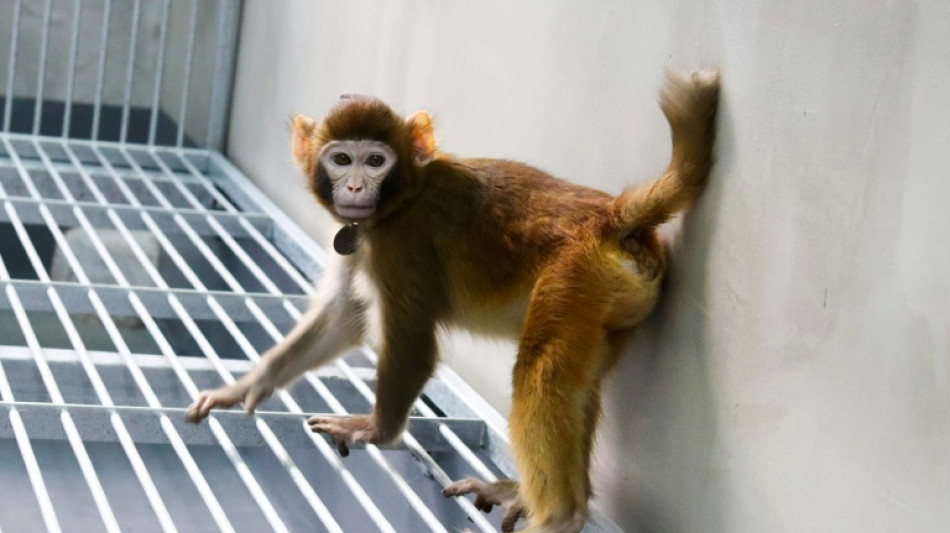
Scientists clone first rhesus monkey using new method / Photo: Zhaodi Liao et Al - Nature Communications/AFP

 Protecting the protectors: racing to save Philippine mangroves

 Expanded World Cup; same old story as Europe dominates quarter-finals

 Morocco's Saibari out of France World Cup quarter-final

 Trump orders new strikes on Iran over attacks on shipping in Hormuz

 PSG's Lee set to join Atletico Madrid

 Iran plays with fire, but calculates Trump will hold back

 Oil surges, stocks slide as Trump says Iran ceasefire over

 Meta to build $9 billion data center in western Canada

 Rogers backs Kane to outshine Haaland in World Cup showdown

 Some US Fed officials considered June rate hike on war fallout

 UN launches appeal for nearly $300 mn in Venezuela quake relief

 US to remove Syria from terror blacklist, in new boost to Sharaa

 Court rejects Trump request to restore his name to Kennedy Center

 MLB pitching great Verlander to retire after 2026 season

 Artificial cloud brightening could tame El Nino, but with risks: study

 Shocked and shaken, Venezuela quake survivors get psychological help

 France, Morocco kick off blockbuster World Cup quarter-finals

 Amorim hails 'ambitious' AC Milan, promises to learn Italian

 Cancer survivor Traeen takes the long road to Tour yellow

 Easing Russian Olympic restrictions 'terrible', says Wimbledon star Kostyuk

 'Unbelievable' Kooij wins Tour de France 5th stage in chaotic sprint finish

 Britain's Fery to face Zverev in Wimbledon semi-finals

 Zverev sees off Fritz to make first Wimbledon semi-final

 Barcelona sets new heat record at 40.7C: weather agencies

 'The Pitt,' 'Hacks' lead Emmy nominations

Scientists in China on Tuesday announced that they have cloned the first healthy rhesus monkey, a two-year-old named Retro, by tweaking the process that created Dolly the sheep.
Primates have proved particularly difficult to clone, and the scientists overcame years of failure by replacing the cloned cells that would become the placenta with those from a normal embryo.
They hope their new technique will lead to the creation of identical rhesus monkeys that can be experimented on for medical research.
However, outside researchers warned that the success rate for the new method was still very low, as well as raising the usual ethical questions around cloning.
Since the historic cloning of Dolly the sheep using a technique called somatic cell nuclear transfer (SCNT) in 1996, more than 20 different animals have been created using the process, including dogs, cats, pigs and cattle.
However it was not until two decades later that scientists managed to clone the first primates using SCNT.
A pair of identical crab-eating macaques named Hua Hua and Zhong Zhong were created using SCNT in 2018 by researchers at the Chinese Academy of Sciences Institute of Neuroscience in Shanghai.
But that breakthrough, led by the institute's Qiang Sun, only resulted in live births in fewer than two percent of attempts.
Qiang was also a senior author of the new research published in the journal Nature Communications.
He told AFP that the team had extensively researched why previous efforts to clone the rhesus monkey (Macaca mulatta) had failed.
In an earlier attempt, one monkey -- out of 35 implanted foetuses -- was born alive, but it died in less than a day.
Qiang said that one of the "major problems" was that the placentas of cloned embryos were showing abnormalities compared to those from in vitro fertilisation.
So the researchers replaced the cells that later become the placenta, which are called the trophoblast, with those from a healthy, non-cloned embryo.
The trophoblast cells provide nutrients to a growing embryo, and turn into the placenta that supplies oxygen and other life-supporting assistance to the foetus.
The technique "greatly improved the success rate of cloning by SCNT" and led to the birth of Retro, Qiang said.
- Human cloning 'unacceptable' -
However Lluis Montoliu, a scientist at the Spanish National Centre for Biotechnology who was not involved in the research, pointed out that just one out of 113 initial embryos survived, meaning a success rate of less than one percent.
If human beings were to ever be cloned -- the great ethical fear of this field of research -- then other primate species would have to be cloned first, he said.
But so far, the poor efficiency of these efforts has "confirmed the obvious: not only was human cloning unnecessary and debatable, but if attempted, it would be extraordinarily difficult -- and ethically unjustifiable," Montoliu said.
Qiang emphasised that cloning a human being was "unacceptable" in any circumstance.
For the SCNT procedure, scientists remove the nucleus from a healthy egg, then replace it with another nucleus from another type of body cell.
The embryo therefore grows into the same creature that donated the replacement nucleus.
A rhesus monkey named Tetra was cloned in 1999 using a different technique called embryo splitting.
But this simpler technique can only produce four clones at once.
Scientists have focused on SCNT in part because it can create far more clones, with the goal of creating identical monkeys to study a range of diseases as well as test drugs.
Ch.Campbell--AT