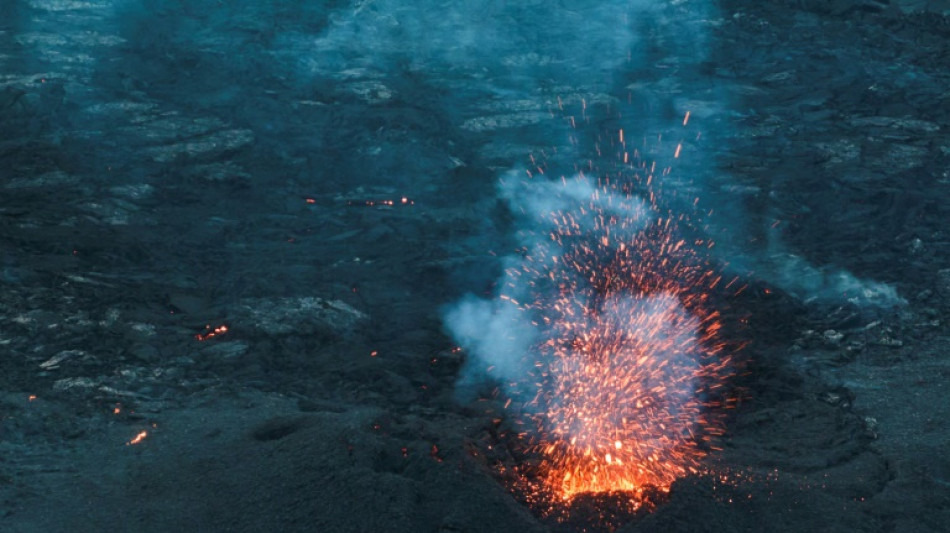
Iceland eruption confirms faultline has reawakened: expert / Photo: Halldor KOLBEINS - AFP/File

 Protecting the protectors: racing to save Philippine mangroves

 Expanded World Cup; same old story as Europe dominates quarter-finals

 Morocco's Saibari out of France World Cup quarter-final

 Trump orders new strikes on Iran over attacks on shipping in Hormuz

 PSG's Lee set to join Atletico Madrid

 Iran plays with fire, but calculates Trump will hold back

 Oil surges, stocks slide as Trump says Iran ceasefire over
 Meta to build $9 billion data center in western Canada

 Rogers backs Kane to outshine Haaland in World Cup showdown

 Some US Fed officials considered June rate hike on war fallout

 UN launches appeal for nearly $300 mn in Venezuela quake relief
 US to remove Syria from terror blacklist, in new boost to Sharaa

 Court rejects Trump request to restore his name to Kennedy Center

 MLB pitching great Verlander to retire after 2026 season

 Artificial cloud brightening could tame El Nino, but with risks: study

 Shocked and shaken, Venezuela quake survivors get psychological help

 France, Morocco kick off blockbuster World Cup quarter-finals
 Amorim hails 'ambitious' AC Milan, promises to learn Italian

 Cancer survivor Traeen takes the long road to Tour yellow
 Easing Russian Olympic restrictions 'terrible', says Wimbledon star Kostyuk

 'Unbelievable' Kooij wins Tour de France 5th stage in chaotic sprint finish

 Britain's Fery to face Zverev in Wimbledon semi-finals

 Zverev sees off Fritz to make first Wimbledon semi-final

 Barcelona sets new heat record at 40.7C: weather agencies

 'The Pitt,' 'Hacks' lead Emmy nominations

A volcanic eruption that has engulfed homes in an Icelandic fishing port confirms that a long-dormant faultline running under the country has woken up, threatening to belch out lava with little warning for years to come, an expert warned on Tuesday.
Glowing lava swallowed several homes on Sunday at the edge of the town of Grindavik, southwest of the capital Reykjavik.
The fishing town was mostly evacuated due to threat of an eruption last month and the most recent volcanic activity has since eased, authorities in the North Atlantic nation said on Monday.
The island straddles the Mid-Atlantic Ridge, a crack in the ocean floor separating the Eurasian and North American tectonic plates.
Sunday's eruption was the fifth in fewer than three years on the Reykjanes peninsula, which had not previously seen one in centuries.
"After eight centuries of a relative break and a complete cessation of surface activity, we have entered a new episode of plate separation which could last several years -- possibly decades," volcanologist Patrick Allard from France's Institut de Physique du Globe de Paris told AFP.
Even before the first of the five eruptions on March 2021, scientists "saw the ground distorting, with magma rising from the depths and seeping into" an area three to 10 kilometres (two to six miles) below the surface, he said.
As that magma bubbled its way upwards through fissures in the Earth, eruptions started to occur.
- 'Ready to erupt' -
The two most recent eruptions -- last month and on Sunday, both threatening Grindavik -- were brief and preceded by very little seismic activity.
This shows that the "magma is very close to the surface, ready to erupt", Allard said.
The thinness of the Earth's crust near the faultline under Iceland will help prompt these magma "pressure releases," he said.
But the amount that will actually burst out of the Earth's surface is not expected to be enormous, he added.
The location of this fragile faultline is likely to continue to be a problem.
It poses a threat to the nearby Svartsengi geothermal plant, which provides electricity and water to the 30,000 residents of the Reykjanes peninsula -- a tenth of Iceland's population.
The eruptions have also forced the closure of the Blue Lagoon, a popular tourist destination near Grindavik famed for its geothermal spas.
Allard said Grindavik was built on lava flows from 800 years ago, which "raises the question as to (the logic behind) the town's very existence".
And there will probably be little warning before the next eruption.
During the last two eruptions, there were only a "few hours of critical seismic activity" to warn that magma was quickly rising to the surface, he said.
There was also a risk of an underwater eruption, which could create an "explosive phenomenon, releasing more volcanic ash".
However experts have said that such an extreme event is considered unlikely to happen on the Reykjanes peninsula.
M.O.Allen--AT