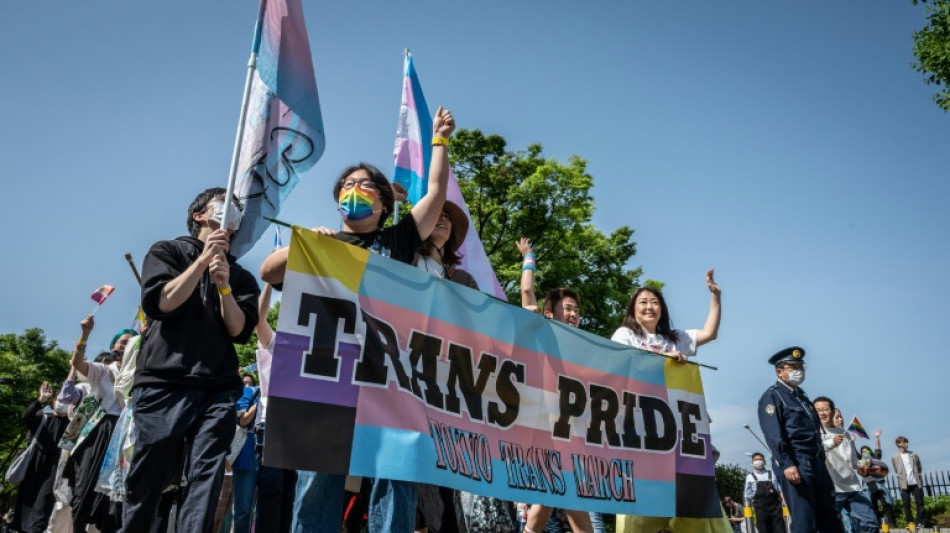
Japan court says 'cruel' gender change sterilisation rule unconstitutional / Photo: Yuichi YAMAZAKI - AFP/File

 H5 bird flu detected in Australian seabird for first time

 Myanmar's pro-democracy revolution weakens five years on
 Hundreds flee homes in Taiwan ahead of biggest typhoon in decades

 Asian stocks rally as SK hynix breathes life back into AI trade

 Humanitarians look to put the AI in aid

 Indian haute couture presence 'overdue', says designer Manish Malhotra

 'Everyone' expects Spain to beat us, says Belgium coach

 France's Galthie says 'hot and cold' Australia still a threat

 Mbappe warns 'a long way to go' for France at World Cup after reaching semis

 Deschamps hails Mbappe after superstar fires France into World Cup semis

 OpenAI number two Simo steps down to focus on health

 Iran buries Khamenei after new fighting with US erupts

 Can ageless Messi keep delivering for Argentina at World Cup?

 Chip titan SK hynix to raise $26.5 bn in blockbuster US listing

 Bayeux Tapestry begins epic journey from France to London

 Mbappe, Dembele fire France past Morocco into World Cup semi-finals

 Chip titan SK hynix readies for mega US listing

 Iyer says India in 'transition' after latest thrashing by England

 Iyer says India in 'transition' after latest England thrashing

 Silencing World Cup hotshot Haaland vital, says England's O'Reilly

 Australian sprint sensation Gout Gout set to miss rest of season

 England thrash India by nine wickets for T20 series win

 Wimbledon run came 'out of nowhere', says finalist Noskova

 India captain Kaur hopes Lord's Test can offset World Cup woes

 China factory fire kills at least 28 people

Japan's top court said on Wednesday that obliging transgender people to be sterilised in order to change their legal gender was unconstitutional.
But the claim from a transgender woman at the centre of the case against having to undergo gender affirmation surgery will be sent back to a lower court for further deliberation, the court said.
The sterilisation rule "restricts a person's free rights not to have their bodies invaded against their will," the supreme court said in the keenly awaited decision that partially overturned its own earlier 2019 ruling.
The requirement imposes a "cruel choice" on those who wish to change gender between "embracing the sterilisation surgery that requires an intense level of bodily invasion" and "relinquishing important legal benefits of being treated according to their gender identity", the court said.
Under rules introduced in 2004, transgender people applying to legally change their gender must meet criteria including forfeiting reproductive capacity -- effectively meaning sterilisation.
Other conditions include being unmarried, not having children and being officially diagnosed with gender dysphoria.
Only a handful of countries around the world allow transgender people to change their status with a simple declaration.
But campaigners say that conditions imposed by Japan, the only Group of 7 wealthy country that does not recognise same-sex marriage or civil unions at a national level, forced people into highly invasive, lengthy and potentially risky medical procedures.
"The procedure for changing one's legally recognised gender, which requires sterilisation surgery and an outdated psychiatric diagnosis, is anachronistic, harmful, and discriminatory," Human Rights Watch had said in a 2019 report.
The advocacy group blasted it as rooted on a "pejorative" notion that transgender identity amounts to a "mental illness".
Recent years have seen traditionally conservative Japan take small steps towards embracing sexual diversity.
In July, Japan's Supreme Court ruled in favour of a transgender bureaucrat who sued the government over access to female toilets at work.
Opinion polls have shown growing support for LGBTQ-friendly laws, especially among younger people, but the ruling Liberal Democratic Party has been reluctant to push ahead with reforms.
And in recent months activists have warned of a rising tide of hateful online rhetoric, particularly targeting transgender women, fuelled in part by contentious debate around anti-discrimination legislation that passed this year, albeit in watered-down form.
- 'Still in pain' -
At the heart of Wednesday's case was a transgender Japanese woman whose claim to be legally listed as female without surgery was rejected.
She has called the obligation to be sterilised a "grave human rights violation and unconstitutional".
"It's extremely rare for the supreme court to rule a law unconstitutional," her lawyer Kazuyuki Minami told reporters on Wednesday.
He added though that it was "sad" that the applicant still "will have to live tomorrow and beyond with her gender not recognised by the law."
The ruling will "ease burdens" on those for whom the sterilisation requirement had been the only hurdle to gender change, but will leave many trans women obliged to undergo surgery on their genitals or wait in limbo for the lower court's decision.
Wednesday's top court ruling has been hotly anticipated among Japan's transgender community, including 34-year-old transgender man Tomoya Asanuma.
At 23, Asanuma's womb and ovaries were removed in order to legally change gender and be allowed to marry his female fiance at the time.
"Making surgery a condition for changing legal gender is too risky for trans people in all aspects -- physically, emotionally and financially," Asanuma said.
"I am still in pain. It's really frustrating to think I wouldn't be suffering as much as I am now, if only I had been allowed to change my gender without surgery."
F.Wilson--AT