Nepal quake sparks revival of traditional craft skills / Photo: Prakash MATHEMA - AFP

 Wallabies skipper Wilson has full faith in rookie flyhalf

 Landslide kills five in Philippines as biggest typhoon in decades nears Taiwan
 Modi visits New Zealand as trade deal sparks India pushback

 Bayeux Tapestry to arrive in London after epic journey from France

 Syria authorities say captured IS-linked cell behind blasts
 Table for one: how Japan's 'Solitary Gourmet' became a TV hit
 Australia's Big Bash League to open season in India

 Disappointment at Morocco's World Cup exit cannot mask pride
 In gas-rich Kazakhstan, many rely on lethal cylinders

 Chip titan SK hynix raises $26.5 bn in blockbuster US listing

 Venezuela quake tragedy threatens to set back democratic transition

 Yamal's best 'yet to come,' warns Spain coach

 'Up to him' - Curry on chance that LeBron lands with Warriors

 Revamped Ireland wary of 'bang in form' Japan

 InterContinental Hotels Group PLC Announces Transaction in Own Shares - July 10

 Morocco coach Ouahbi vows team will come back stronger after World Cup exit

 Rennie says Italy won't catch All Blacks off guard

 McIlroy encouraged by 'great start' to Scottish Open

 England chase World Cup glory as Haaland allows Norway to dream
 'When it's Kylian, there's no problem': Deschamps after France into semis

 Mbappe strikes again as France beat Morocco to reach World Cup semi-finals

 Sick Olympic champion McKeown pulls out of Commonwealth Games, PanPacs

 Traeen out of Tour de France after losing yellow jersey

 Ukrainian sports minister slams IOC's 'cynical' Russia decision

 Leonard return to Raptors on hold pending Clippers probe

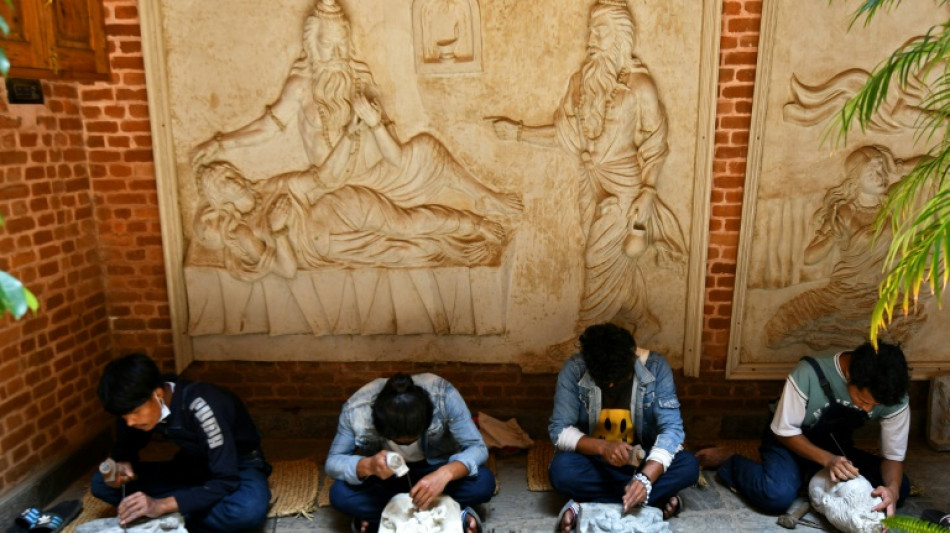
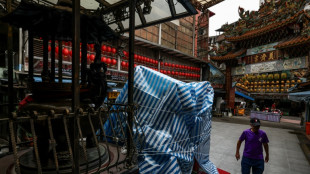
Nepal's deadly earthquake eight years ago reduced swathes of centuries-old monuments to rubble, but the vast task of restoration has sparked a revival of once-fading architectural craft skills.
Carpenter Dinesh Tamang is one of hundreds of craftspeople who learned a new trade in the quake's aftermath.
"I got a chance to work in reconstruction projects, to rebuild damaged temples and houses," said Tamang, who was unemployed before the 7.8 magnitude earthquake that killed nearly 9,000 people.
"It is very rewarding work," he said while carefully carving an intricate pattern on a wooden panel with a chisel and mallet.
The 2015 quake also destroyed hundreds of monuments and royal palaces -- including the Kathmandu Valley's UNESCO World Heritage sites -- that had drawn visitors from around the world.
In deeply religious Nepal, temples and heritage sites are not just tourist attractions, but an integral part of cultural and spiritual life.
The public demand for their rebuilding fueled a need for workers adept at traditional architectural techniques including stone masonry and intricate wood and metal work.
"Nepal is rich in cultural heritage," Tamang said. "You see temples everywhere and I was always fascinated by the designs on the wood".
Nepal Vocational Academy, where Tamang enrolled, said it had trained hundreds in traditional skills since the quake.
"Even though the quake was a tragic event, it has created opportunities in different sectors," said Rabindra Puri, a heritage conservationist and the academy's founder.
"The demand for skilled manpower drastically increased".
Puri said that the academy expanded its facility after the quake to meet the surge in demand for training.
"As far as I know, none of our graduates are unemployed," he said.
- 'Live on after us' -
Many initially feared Nepal lacked the skills needed for the huge task of rebuilding.
The palaces and temples damaged date back to the period between the 12th and 18th centuries when the Kathmandu Valley was divided into the three kingdoms of Kathmandu, Patan and Bhaktapur.
The wood carvers, stone sculptors and metal workers who created the spectacular temples and palaces were once feted from far away and paid handsomely from the royal purse.
These crafts were historically carried out exclusively by families belonging to the Newa ethnic group and passed on through generations. But over time many opted for other professions.
"The fathers didn't want to teach the sons, and sons didn't want to learn, so it was close to disappearing," Puri said.
The funding for reconstruction has made these professions more economically sustainable.
The government has poured in over $45 billion to restore its heritage sites, with additional projects funded from countries including neighbouring China and India -- as well as Japan, Sri Lanka, Switzerland and the United States.
About 80 percent of the 920 heritage structures that were flattened or damaged have been reconstructed.
Heritage conservationist Rohit Ranjitkar, director of the Kathmandu Valley Preservation Trust, said that while the renewed interest in learning traditional crafts is encouraging, the focus should be on quality.
"The quality must match the monuments we have... These skills that have been passed on from generation to generation cannot be learnt with a few months' training," he said.
"Practice is important... We need to see how to encourage them, so that they can carry on the skills."
Stonework expert Kancha Ranjitkar, 82, who began working with his father as a teenager, said he felt happy alongside younger craftspeople.
"Many of the skills are vanishing," he said. "But the quake gave a chance to pass on our knowledge to the next generation... for it to live on after us."
F.Wilson--AT