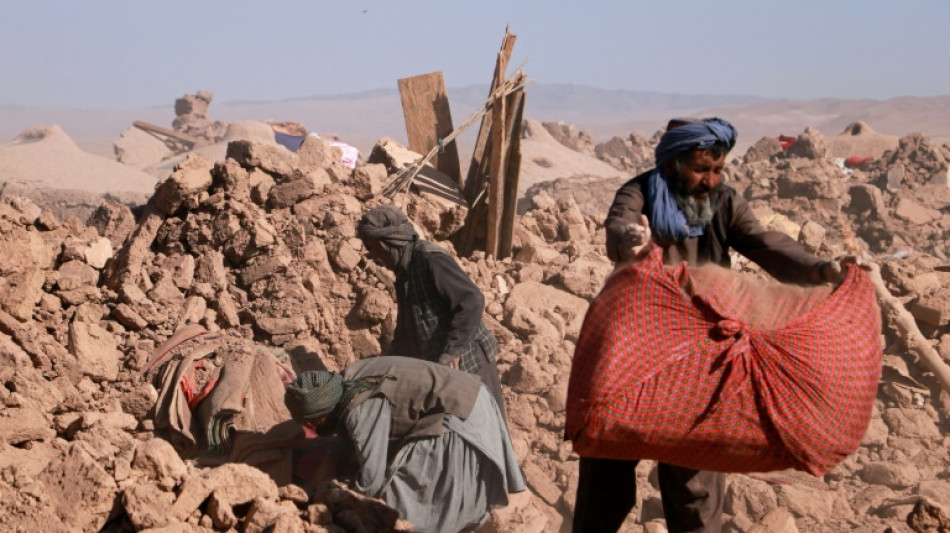
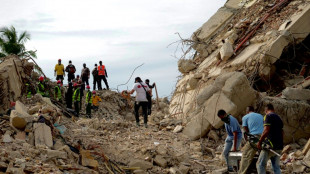
Vast majority of dead in Afghan quakes women and children / Photo: Mohsen KARIMI - AFP

 India's choked pavements fail pedestrians
 It's coming home: Bayeux tapestry arrives in London in overnight operation

 Pacific Islands reject missile test in 'blue continent'
 Wallabies skipper Wilson has full faith in rookie flyhalf

 Landslide kills five in Philippines as biggest typhoon in decades nears Taiwan
 Modi visits New Zealand as trade deal sparks India pushback

 Bayeux Tapestry to arrive in London after epic journey from France

 Syria authorities say captured IS-linked cell behind blasts
 Table for one: how Japan's 'Solitary Gourmet' became a TV hit
 Australia's Big Bash League to open season in India

 Disappointment at Morocco's World Cup exit cannot mask pride
 In gas-rich Kazakhstan, many rely on lethal cylinders

 Chip titan SK hynix raises $26.5 bn in blockbuster US listing

 Venezuela quake tragedy threatens to set back democratic transition

 Yamal's best 'yet to come,' warns Spain coach

 'Up to him' - Curry on chance that LeBron lands with Warriors

 Revamped Ireland wary of 'bang in form' Japan

 Caledonia Mining Corporation Plc: Notification of Relevant Change to Significant Shareholder

 OpenAI number two Simo steps down to focus on health

 Iran buries Khamenei after new fighting with US erupts

 Can ageless Messi keep delivering for Argentina at World Cup?

 Chip titan SK hynix to raise $26.5 bn in blockbuster US listing

 Bayeux Tapestry begins epic journey from France to London

 Mbappe, Dembele fire France past Morocco into World Cup semi-finals

 Chip titan SK hynix readies for mega US listing

More than 90 per cent of those killed in a series of earthquakes in western Afghanistan were women and children, UNICEF said Wednesday, as fresh tremors terrorised residents of villages flattened by the disaster.
The magnitude 6.3 earthquake hit at dawn around 30 kilometres (19 miles) north of Herat city -- the latest in a series of quakes that have left thousands homeless since the weekend.
In total more than 1,000 people people have been killed and hundreds more injured, the Afghan government said Wednesday, revising down an earlier toll of over 2,000.
The brunt of fatalities was borne by women and children when the first magnitude 6.3 quake hit Saturday around 11:00 am (0630 GMT), said Herat-based UNICEF field officer Siddig Ibrahim.
"Women and children are often at home, tending to the household and caring for children, so when structures collapse, they are the most at risk," he said in a statement.
Forty-year-old Mohammad Naeem told AFP he lost 12 relatives, including his mother, after Saturday's earthquakes.
"We can't live here anymore. You can see, our family got martyred here. How could we live here?"
- Children scared to sleep -
At least one person was killed and around 130 injured in the latest quake on Wednesday, according to officials.
Some of the wounded were hit by the debris of already destroyed homes, said Abdul Zahir Noorzai, ambulance manager for Herat Regional Hospital.
Thirty-two-year-old Abdul Qudos said survivors had been left terrified by the multiple aftershocks.
"We are so scared that even when we see the trees moving (in the wind), we think it's another earthquake coming," he told AFP.
Earthquakes are frequent in Afghanistan and in the west and centre of the country are mostly caused by the Arabian and Eurasian tectonic plates jutting against each other.
Public health minister Qalandar Ebad attributed the confusion over fatality figures to the remoteness of the area and double reporting during the rescue effort.
"When whole villages are destroyed and populations erased... verifying the affected and martyred people, and the number of wounded, is a very difficult process," he said, adding that 2,400 had been injured.
- Casualties in flux -
Volunteers have been digging for survivors and bodies from the earlier quakes which totally destroyed at least six villages in rural Zenda Jan district and affected more than 12,000 people, the United Nations said.
Providing shelter on a large scale will be a challenge for Afghanistan's Taliban authorities, who seized power in August 2021, and have fractious relations with international aid organisations.
"That area is very cold, staying there after the evening is very difficult," said minister Ebad. "We know they could live there in tents for one month, but more than that would probably be very difficult."
Most homes in rural Afghanistan are made of mud and built around wooden support poles, with little in the way of steel or concrete reinforcement.
Multi-generational extended families generally live under the same roof, meaning serious earthquakes can devastate communities.
Afghanistan is already suffering a dire humanitarian crisis, with the widespread withdrawal of foreign aid following the Taliban's return to power.
Herat province, on the border with Iran, is home to around 1.9 million people, and its rural communities have already been suffering from a years-long drought.
L.Adams--AT