Thousands of Afghans out in cold after deadly quakes / Photo: Mohsen KARIMI - AFP

 India's choked pavements fail pedestrians
 It's coming home: Bayeux tapestry arrives in London in overnight operation

 Pacific Islands reject missile test in 'blue continent'
 Wallabies skipper Wilson has full faith in rookie flyhalf

 Landslide kills five in Philippines as biggest typhoon in decades nears Taiwan
 Modi visits New Zealand as trade deal sparks India pushback

 Bayeux Tapestry to arrive in London after epic journey from France

 Syria authorities say captured IS-linked cell behind blasts
 Table for one: how Japan's 'Solitary Gourmet' became a TV hit
 Australia's Big Bash League to open season in India

 Disappointment at Morocco's World Cup exit cannot mask pride
 In gas-rich Kazakhstan, many rely on lethal cylinders

 Chip titan SK hynix raises $26.5 bn in blockbuster US listing

 Venezuela quake tragedy threatens to set back democratic transition

 Yamal's best 'yet to come,' warns Spain coach

 'Up to him' - Curry on chance that LeBron lands with Warriors

 Revamped Ireland wary of 'bang in form' Japan

 Caledonia Mining Corporation Plc: Notification of Relevant Change to Significant Shareholder

 OpenAI number two Simo steps down to focus on health

 Iran buries Khamenei after new fighting with US erupts

 Can ageless Messi keep delivering for Argentina at World Cup?

 Chip titan SK hynix to raise $26.5 bn in blockbuster US listing

 Bayeux Tapestry begins epic journey from France to London

 Mbappe, Dembele fire France past Morocco into World Cup semi-finals

 Chip titan SK hynix readies for mega US listing

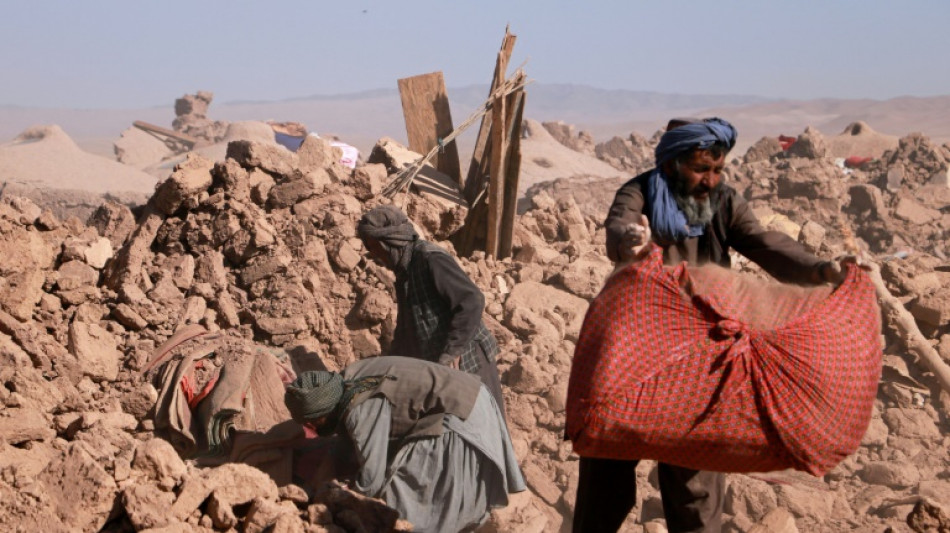
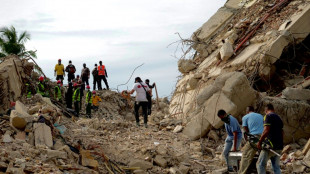
Thousands of Afghans who survived a powerful earthquake that killed more than 2,00 people were bracing for a winter of homelessness on Tuesday, as rescuers made last-ditch efforts to find survivors.
Volunteers have worked with spades and pickaxes in Herat province since Saturday's deadly magnitude 6.3 quake -- followed by powerful aftershocks -- while others dug graves instead.
The United Nations said more than 12,000 people, from some 1,700 families, are estimated to have been affected.
It said "100 percent" of homes were destroyed in 11 villages of Zenda Jan district.
Zareen, in the village of Nayeb Rafi, where 11 of his family members were killed in the crush of falling masonry, said aid tents would not withstand the winter storms.
"If the government doesn't take us away or help us, we will be stuck here," the man in his 70s told AFP.
Providing shelter on a large scale will be a challenge for Afghanistan's Taliban authorities, who seized power in August 2021, and have fractious relations with international aid organisations.
"Not a single house is left, not even a room where we could stay at night," said 40-year-old Mohammad Naeem, who told AFP he lost 12 relatives including his mother.
"We can't live here anymore. You can see, our family got martyred here. How could we live here?"
- Discharged patients homeless -
In the provincial capital of Herat city -- 30 kilometres (19 miles) southeast of the quake epicentres in hard-to-reach Zenda Jan district -- Doctors Without Borders said the injured now faced a new ordeal.
"More than 340 patients discharged yesterday don't want to leave the hospital as they have no homes to return to," the charity said on social media site X.
Local and national officials gave conflicting counts of the number of dead and injured, but the disaster ministry has said 2,053 people died.
"We can't give exact numbers for dead and wounded as it is in flux," said disaster management ministry spokesman Mullah Janan Sayeq.
The UN said Tuesday the death toll stood at nearly 1,300 with nearly 500 more still missing, the majority of them women.
Afghanistan is frequently hit by deadly earthquakes, but the weekend disaster is the worst to strike the impoverished country in more than 25 years.
- 'Crisis on top of crisis' -
Taliban authorities have banned women from working for UN and non-governmental organisations (NGOs) in Afghanistan, making it difficult to assess family needs in deeply conservative parts of the country.
Amnesty International said the Taliban government should ensure that rescue and relief efforts are carried out "without discrimination" and guarantee unrestricted access to the affected regions to humanitarian agencies.
"It is critical that all assistance meets the needs of the most at-risk groups who often face compounded challenges in crisis situations, including women," said South Asia regional researcher Zaman Sultani.
Most rural homes in Afghanistan are made of mud and built around wooden support poles, with little in the way of modern steel reinforcement.
Multi-generational extended families generally live under the same roof, meaning disasters such as Saturday's quake can devastate local communities.
Afghanistan is already suffering a dire humanitarian crisis, with the widespread withdrawal of foreign aid following the Taliban's return to power.
Save the Children called the quakes "a crisis on top of a crisis".
Herat province -- home to around 1.9 million people on the border with Iran -- has also been hit by a years-long drought that has crippled many hardscrabble farm communities.
The country is prone to quakes, especially in the Hindu Kush mountain range, which lies near the junction of the Eurasian and Indian tectonic plates.
More than 1,000 people were killed and tens of thousands left homeless in June last year after a 5.9-magnitude quake struck the impoverished province of Paktika.
More than 4,000 people died in a magnitude 6.5 quake that struck Takhar province in 1998.
S.Jackson--AT