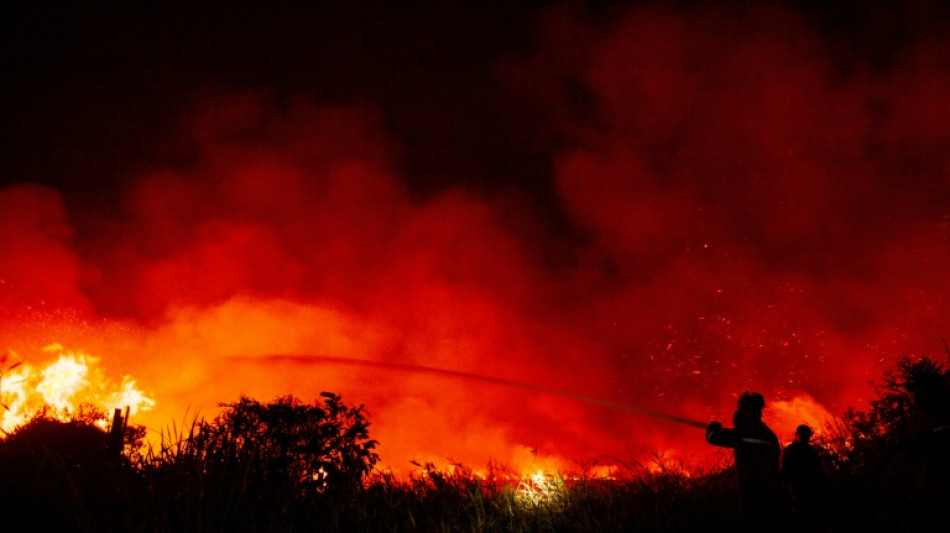
Climate change affecting ability to prevent US wildfires: study / Photo: Al ZULKIFLI - AFP

 Gagan Gupta, man on a mission to industrialise Africa
 Eleven dead, 19 missing as Spain wildfire roars through southern Spain

 Man nearly sucked out of 'detached' window on Ryanair flight

 Record visitors, record taxes: Vienna cashes in on tourist boom

 Landslides kill 15 in Philippines as biggest typhoon in decades nears Taiwan
 Jungle spirit: Myanmar fighters try to keep hope alive

 Beirne hails 'special moment' as he prepares to captain Ireland

 Indonesia says landfill fire near Jakarta extinguished

 Spain aim for World Cup date with France by beating Belgium

 Bayeux Tapestry arrives in London after epic journey from France
 North Korea vows boost to nuclear buildup, military intelligence

 H5 bird flu detected in Australian seabird for first time

 Myanmar's pro-democracy revolution weakens five years on

 Hundreds flee homes in Taiwan ahead of biggest typhoon in decades

 Asian stocks rally as SK hynix breathes life back into AI trade

 Humanitarians look to put the AI in aid

 Indian haute couture presence 'overdue', says designer Manish Malhotra

 'Everyone' expects Spain to beat us, says Belgium coach
 France's Galthie says 'hot and cold' Australia still a threat

 Mbappe warns 'a long way to go' for France at World Cup after reaching semis

 Deschamps hails Mbappe after superstar fires France into World Cup semis

 What is the Best Social Media Platform for Body Piercing Artists?

 Caledonia Mining Corporation Plc: Notification of Relevant Change to Significant Shareholder

 OpenAI number two Simo steps down to focus on health

 Iran buries Khamenei after new fighting with US erupts

Shifting weather patterns caused by climate change are limiting when controlled burns can be carried out to prevent wildfires in the western United States, a new study warns.
Controlled burns, also known as prescribed fires, are a tool to preemptively dispose of combustible vegetation with the goal of preventing larger, uncontrolled fires.
But they are only possible under specific conditions -- so-called burn windows -- when undergrowth is neither so dry it risks burning out of control nor so damp it won't burn at all.
The number of burn windows in a year varies by region and climate, but conditions are generally best in spring or autumn in the western United States, the region covered by the study.
To examine how climate change might affect that, scientists from the University of California and Washington State University used computer modelling.
They looked how many days a year met burn window conditions historically, and how that might change in a "moderate warming" scenario of a two-degree Celsius temperature increase.
Despite regional variations, they found a clear trend, with suitable days already decreasing and likely to do so further.
In the southern part of the area studied, the number of lost days in decades ahead ranged from 15 to 30 a year, with smaller decreases further north.
In localised areas, modelling showed small increases in the number of suitable days, though the paper warns those gains may be temporary.
That's because while dry conditions can initially make circumstances more favourable in damp areas, eventually the balance can tip and leave vegetation too dry to burn safely.
"Contemporary practitioners of prescribed fire are operating under climate and vegetation conditions that are increasingly outside the envelope of historical experience," the authors wrote.
The paper was published Tuesday in Communications Earth and Environment, a Nature journal.
- 'Acceptable trade-offs' -
The findings offer some hope that shifting policies could address shrinking burn windows.
The authors note that winter, while not currently a time used for prescribed burns in the region, should stay as favourable, or become even more so in some areas.
That supports calls "for an expanded year-round fire management workforce whose responsibilities extend beyond fighting wildfires to also encompass the management of prescribed fire," the authors wrote.
One complicating factor is the smoke generated by controlled fires, with burn windows currently dictated in part by the likelihood of burning affecting local residents.
The researchers found "low-level stagnation" -- a combination of wind and rain patterns -- is likely to increase with climate change.
That could further constrain policymakers, who are generally keen to limit burning at times when it could leave smoke sitting over local communities.
The authors suggested policymakers need to weigh the potentially greater air pollution risks if wildfires erupt.
"Greater tolerance of dispersed smoke emissions from prescribed fires may potentially be deemed an acceptable trade-off to reduce the risk of extreme air pollution episodes resulting from catastrophic wildfire smoke events."
While the study only covers the western United States, wildfires have ravaged areas from Greece to Indonesia this year.
Australia carried out controlled burning earlier this month in preparation for a looming bushfire season.
Unusually wet conditions this year have produced large amounts of undergrowth that experts fear could contribute to the worst bushfire season since the country's 2019-2020 "Black Summer".
N.Mitchell--AT