Argentina's ESMA torture center: hell becomes heritage / Photo: LUIS ROBAYO - AFP/File

 Syria says IS behind Damascus blasts, finds explosives cache
 Nasdaq dips as SK hynix arrives in NY

 Fiji captain shrugs off chairman's criticism ahead of England clash
 Hundreds welcome Salah's Egypt home after best World Cup run
 Piercing, matcha rituals lead Noskova in Kvitova's footsteps

 France wildfires burn twice as much land as last year: official

 Mandhana's fifty lights up inaugural women's Test at Lord's

 England World Cup winner Stiles died with brain injury, court told
 Stocks rise as SK hynix boosts AI trade

 England bowl against India in historic first women's Test at Lord's

 Eleven dead, 19 missing as wildfire roars through southern Spain
 EU tells Meta to change Facebook, Instagram's 'addictive design'

 EasyJet accepts rival takeover bid from US investor Apollo
 UK schools, mentors team up to rescue 'lost boys' with football
 India's choked pavements fail pedestrians
 It's coming home: Bayeux tapestry arrives in London in overnight operation

 Pacific Islands reject missile test in 'blue continent'
 Wallabies skipper Wilson has full faith in rookie flyhalf

 Landslide kills five in Philippines as biggest typhoon in decades nears Taiwan
 Modi visits New Zealand as trade deal sparks India pushback
 Bayeux Tapestry to arrive in London after epic journey from France

 Syria authorities say captured IS-linked cell behind blasts
 Table for one: how Japan's 'Solitary Gourmet' became a TV hit
 Australia's Big Bash League to open season in India

 Disappointment at Morocco's World Cup exit cannot mask pride
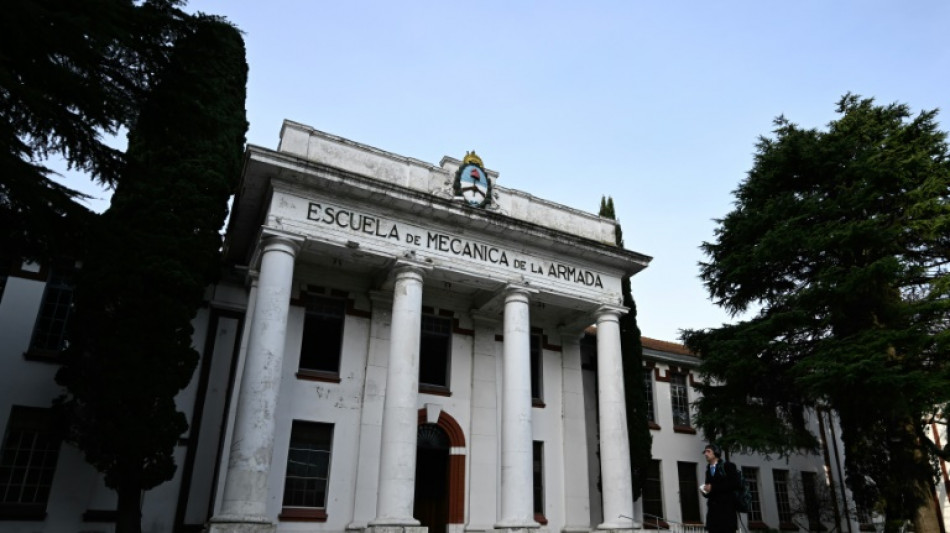
The ESMA, the most notorious murder and torture center among hundreds operated by Argentina's 1976-83 military dictatorship, stands today as a reminder of the brutality humans are capable of.
Inscribed Tuesday on the UNESCO list of World Heritage sites, the center's four-letter acronym still manages to send a shudder down Argentine spines.
The ESMA is emblematic of a tragic period in the South American country's history that left an estimated 30,000 people killed or forcibly disappeared, according to rights groups.
Of those, about 5,000 entered the ESMA. Very few reemerged.
The ESMA, a former navy mechanical school, was the most active of the dictatorship's clandestine detention centers, and the most feared. Its name is an acronym for Escuela Superior de Mecanica de la Armada.
Here, prisoners were tortured, beaten, raped, kept in chains for months on end, hooded -- all in the hopes they would give up other people suspected of being "subversives."
Pregnant detainees had their babies taken and given to families with connections to the dictatorship. Several still don't know their true identities today.
And every week -- generally on a Wednesday -- detainees were rounded up for what they were told were "transfers" but were in fact so-called death flights during which prisoners were thrown out of planes over the River Plate -- both dead and alive.
"The worst of the state terrorism of the last military dictatorship in Argentina was expressed there," President Alberto Fernandez said after the announcement from a UNESCO World Heritage Convention in Saudi Arabia.
- Never forget -
The ESMA today is officially a "Space for Memory and for the Promotion and Defense of Human Rights" -- a reminder of a blemish on history that must never be repeated.
Photographs of hundreds of victims line the walls. Many were mere teens.
Former detainee Eduardo Giardino, on a visit to the museum he remembers as his personal hell from 32 years earlier, took a tour of "Capuchita" -- the attic where he was held from 1978 to 1980 in an individual cage.
"I asked the museum guides to leave me alone in 'Capuchita'," the 68-year-old told AFP. "I felt the need to lie down on the floor again, to relive it, but... as a free person."
Former soldiers attached to the ESMA and other such centers are still being tried today for crimes they committed there: in total, 1,159 have been convicted to date and another 366 cases are still open.
The ESMA is located in the middle of a vast park in Nunez, a peaceful suburb of the bustling capital.
From inside its walls, inmates remember hearing street noises, school bells ringing, and crowds clamoring at the Monumental Stadium which hosted the 1978 FIFA World Cup final between Argentina and the Netherlands. Normal life seemed so near yet so far away.
- 'It hurts' -
"The building is a... witness" to what happened. "Going through it hurts but it is healthy, because it does not allow us to distort history," said Ricardo Coquet, a 70-year-old survivor of torture.
"Having survived at ESMA is luck. The important thing now is to.. bear witness," he told AFP.
The ESMA's three-storey building was first opened in 1928 as a training center. An officers' mess that later served as the illegal detention center was constructed in 1948.
When the military grabbed power in 1976, the ESMA became the center of the military's most brutal operations against civilian activists or anyone suspected of a "subversive" allegiance.
The site was nearly lost: the post-dictatorship government of Carlos Menem wanted to destroy it in 1998 to erect a monument in its place, but widespread protests stopped him.
And in 2004, Menem's successor Nestor Kirchner announced it would become a memorial museum.
Some 150,000 people visit the ESMA every year, tourists and students alike, and partake in activities for reflection and debate about what happened there.
In its submission to UNESCO for the ESMA to be declared a heritage site, the Argentine government argued it was a "symbol of the genocide" that took place in the country.
"It is incontrovertible proof of the State terrorism that inflicted extreme criminal violence on society at large," said the proposal.
S.Jackson--AT