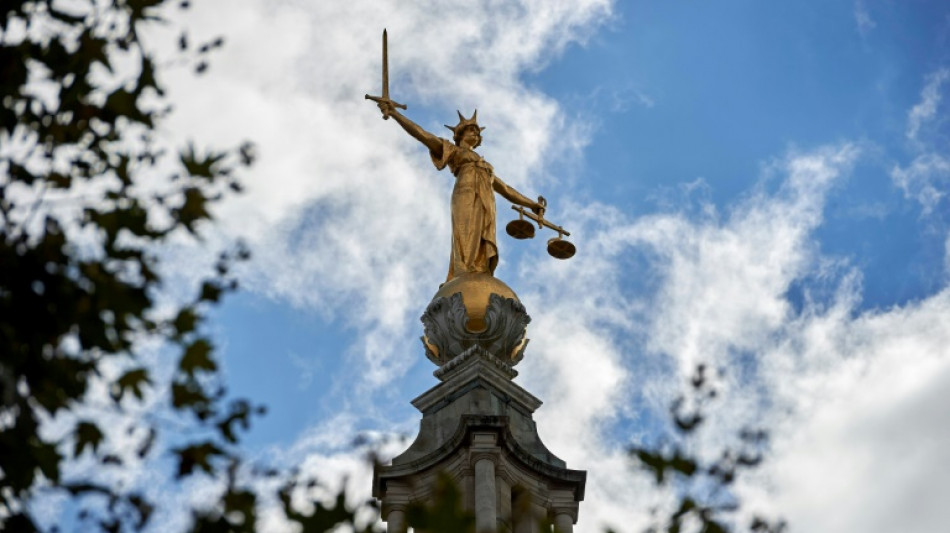
UK criminals to be forced to attend their sentencing / Photo: Niklas HALLE'N - AFP

 New Zealand, India form 'strategic partnership'

 Courtois 'proud' as sun sets on Belgium's 'Golden Generation'

 Economic uncertainty looms over Venezuela quake zone

 'Beast' Haaland a different player to me, says Kane

 My goals don't matter if we win World Cup, says Yamal

 Spain's Merino living 'wildest dreams' with late World Cup winners

 Apple sues OpenAI for stealing trade secrets

 Spain set up World Cup semi-final with France after late win against Belgium

 Alfred trumps Thomas in battle of Olympic sprint champions

 Brutal heat wave forecast for western US this weekend

 Music industry launches AI-generated content labels

 SK hynix surges on first day of trading on Wall Street

 Edwards leaves role with Liverpool owners FSG

 Wemby to Spurs fans: 'I'm here to stay, whatever it takes'

 Trump administration weakens habitat protections for endangered species

 Scheffler misses first cut in four years as McIlroy leads at Scottish Open

 Nearly 50 abducted pupils, teachers rescued in Nigeria

 Wanyonyi sets new world best in men's 1,000m

 Djokovic expects to be back at Wimbledon next year

 Sinner, Zverev power into Wimbledon final

 Trump says agreed to more Iran talks but insists truce over

 Zverev hungry for Wimbledon glory after Paris breakthrough

 England risk losing Guehi for Norway World Cup quarter-final

 UK police launch murder probe into ex-MP's death

 Woad is unruffled by the lake as she sails into Evian lead

Judgescould be given the power to order criminals to attend their sentencing under planned legislation announced Wednesday by the UK's justice ministry.
It comes after offenders in several high-profile trials were not in court to hear their sentence and statements from the victims' families, prompting repeated calls for a change in the law.
Last week nurse Lucy Letby refused to attend her sentencing for murdering seven babies and attempting to kill six other infants.
Under the proposed reforms, which will apply in England and Wales, judges will have the discretionary power to order criminals to attend sentencing hearings, the justice ministry said.
Custody officers will be able to use "reasonable force" to make the criminals appear in the dock or by video link, "meaning every effort will be made for victims and their families to see justice delivered".
Those who continue to resist attending their sentencing despite a judge's order may face an extra two years behind bars, according to the ministry.
This penalty will apply in cases where the maximum sentence is life imprisonment. Typically, anyone sentenced to life has a minimum tariff to serve before they can be considered for parole.
"It is unacceptable that some of the country's most horrendous criminals have refused to face their victims in court," Prime Minister Rishi Sunak said.
"They cannot and should not be allowed to take the coward's way out," he added.
Sunak said the government would submit proposals to parliament in the coming weeks, calling the move "the right thing to do".
"People rightly expect criminals to face up to the consequences of their actions," he added.
- Concern -
Some lawyers have expressed concern about making attendance for sentencing compulsory, citing fears that the use of force could cause injury to defendants or staff, and disrupt proceedings.
The government, which has been accused of underfunding the criminal justice system for years, at the weekend announced plans to impose more whole-life orders for the worst killers.
Currently, 70 prisoners are serving sentences from which they will never be considered for release.
A torture expert called on the UK government to urgently review indefinite sentences imposed under a previous initiative that has now been scrapped.
Alice Jill Edwards, a special rapporteur to the UN on torture and other cruel, inhuman or degrading treatment or punishment, said nearly 2,900 prisoners were still serving such sentences, which were imposed in England and Wales from 2005-2012.
They were given to offenders deemed to pose a significant risk to public safety until they were no longer considered a threat.
"For many these sentences have become cruel, inhuman and degrading," she said, highlighting UK government figures from 2021 that 65 so-called Imprisonment for Public Protection (IPP) prisoners had killed themselves.
"They have been acknowledged by successive UK governments and even described as indefensible by a justice minister -- yet they persist," she added, calling for better rehabilitation.
"As a general rule, indeterminate sentences should be used sparingly and only for the most serious crimes and offenders. Sentencing should be assessed on an individual basis, taking into account all relevant factors."
N.Mitchell--AT