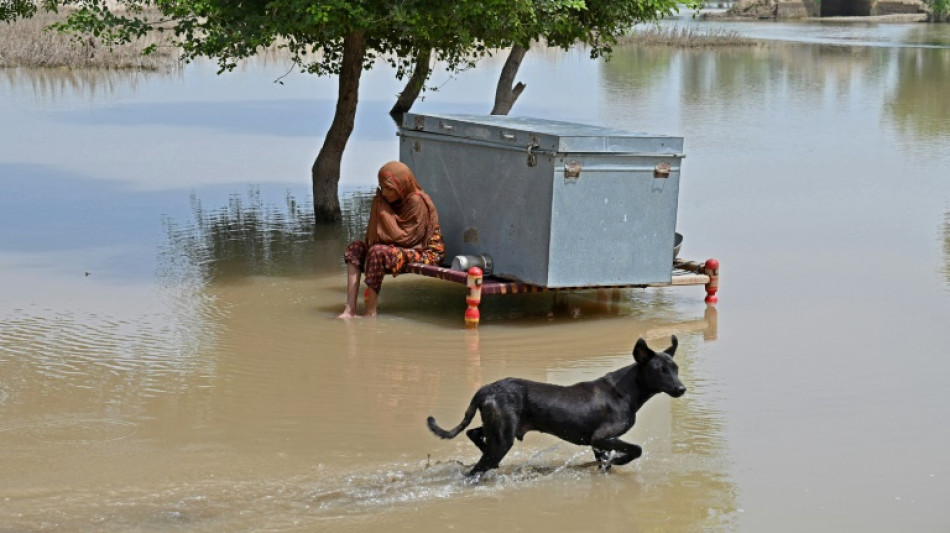
Floods drown hope in Pakistan's impoverished Punjab villages / Photo: Arif ALI - AFP

 New Zealand, India form 'strategic partnership'

 Courtois 'proud' as sun sets on Belgium's 'Golden Generation'

 Economic uncertainty looms over Venezuela quake zone

 'Beast' Haaland a different player to me, says Kane

 My goals don't matter if we win World Cup, says Yamal

 Spain's Merino living 'wildest dreams' with late World Cup winners

 Apple sues OpenAI for stealing trade secrets

 Spain set up World Cup semi-final with France after late win against Belgium

 Alfred trumps Thomas in battle of Olympic sprint champions

 Brutal heat wave forecast for western US this weekend

 Music industry launches AI-generated content labels

 SK hynix surges on first day of trading on Wall Street

 Edwards leaves role with Liverpool owners FSG

 Wemby to Spurs fans: 'I'm here to stay, whatever it takes'

 Trump administration weakens habitat protections for endangered species

 Scheffler misses first cut in four years as McIlroy leads at Scottish Open

 Nearly 50 abducted pupils, teachers rescued in Nigeria

 Wanyonyi sets new world best in men's 1,000m

 Djokovic expects to be back at Wimbledon next year
 Sinner, Zverev power into Wimbledon final

 Trump says agreed to more Iran talks but insists truce over

 Zverev hungry for Wimbledon glory after Paris breakthrough

 England risk losing Guehi for Norway World Cup quarter-final

 UK police launch murder probe into ex-MP's death
 Woad is unruffled by the lake as she sails into Evian lead

The coursing floods in eastern Pakistan first swallowed Nasreen Bibi's corn crop, then the cattle that fed on it, and finally her family home.
They retreated to the roof to escape the rising water, before fleeing for their lives by boat.
"We didn't bring any of our belongings with us, everything we own is abandoned back there," said Bibi, who guesses her age in the 30s, from a relief camp inside a school in Mandi Ahmedabad, a village in eastern Punjab province.
"There is nothing left back home," she said, wiping away tears in a tent she shares with three young daughters.
"Fear plays on my children's minds."
Swaths of Pakistan's breadbasket were inundated this month, with at least 130,000 people evacuated, after the Sutlej river burst its banks and spilled over hundreds of villages and thousands of acres.
The head of Punjab's government, Mohsin Naqvi, said the flooding was caused by India releasing excess reservoir water into the Sutlej river, causing flooding downstream on the Pakistani side of the border.
With the water slowly receding, a ramshackle armada of 40 boats makes twice-daily food and aid deliveries to 80 water-bound villages where men perch on roofs guarding sodden possessions.
The floodwaters are still some eight feet (2.4 metres) deep, and the boats skim past the tops of waterlogged corn stalks blanched by the sun.
A family's financial security depends on agriculture in this largely impoverished corner of Pakistan.
Mud houses lie in ruins, with tumbled walls pooled in stagnant water, in Falak De Bheni, a village of 100 homes surrounded by drowned fields of sesame and rice.
"I don't want to plant a crop here next year, my heart can't bear it," Muhammad Tufail, 38, said as he stood at his ruined door surveying the damage.
"I don't even know how much money I spent, how many troubles I went through, to plant these crops. But the flood has left nothing in its wake."
More than 175 people were killed in Pakistan in rain-related incidents since the monsoon season began in late June, mainly due to electrocution and buildings collapsing, emergency services have reported.
- Flooding back -
Large tracts of rural Pakistan were ruined by record monsoon floods last summer that scientists linked to climate change and from which it is still recovering.
A third of the country was submerged and 1,700 people were killed, while eight million were displaced.
The villages along the Sutlej River were spared in that deluge but are now battling the highest water levels in 35 years, authorities have said.
The assistant commissioner of Dipalpur -- the hardest-hit area in this year's flood -- said 11 rescue centres and five relief camps had been set up, with 4,600 emergency boat trips made since the floods came in mid-August.
The flooded villages of Dipalpur remain without electricity two weeks after the floods started.
Most of the cattle have been evacuated but those left behind have nothing left to feed on.
"Fodder has washed away," said 50-year-old Taj Bibi, struggling to keep a buffalo, a cow and a calf alive on leaves chopped from trees.
"Our cattle are begging us for food but we have nothing to give them," she said. "We are dying of hunger and so are our animals."
At Bashir De Bheni, a small hamlet of 15 houses built on the submerged river bank, rescue workers dropped off antibiotics and rehydration medicine for a toddler suffering diarrhoea and high fever.
"Every problem imaginable has befallen us," said 60-year-old villager Muhammad Yasin.
N.Walker--AT