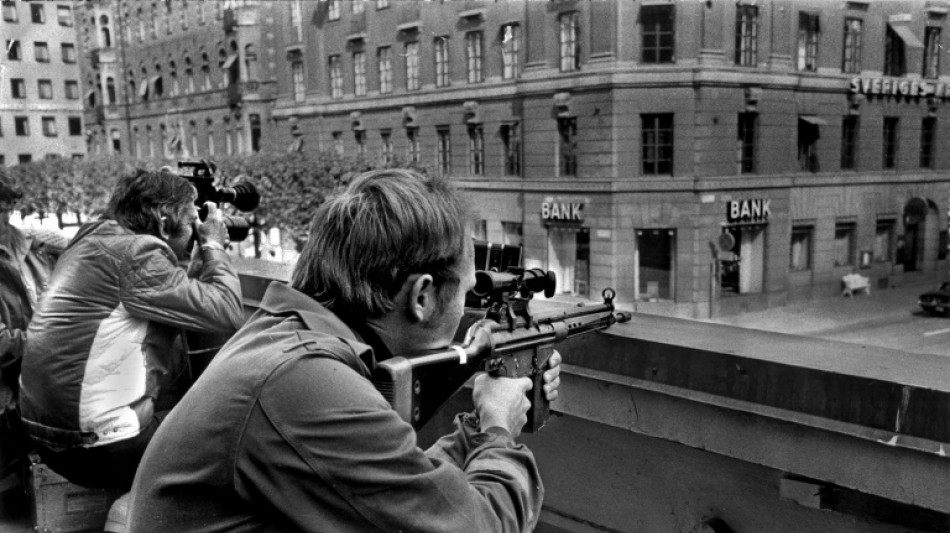
50 years on, the enduring myth of Stockholm Syndrome / Photo: ROLAND JANSSON - TT NEWS AGENCY/AFP/File

 Iran hits back at Trump after insists truce over

 Scaloni wants 'never-say-die' legacy for Argentina

 Scaloni wants Argentina's legacy to be 'never say die'

 Spain into World Cup semi-final with France after late strike against Belgium

 Boeing unveils new 737 MAX production line as aviation giant charts comeback
 Wemby inks Spurs extension, tells fans 'I'm here to stay'

 Courtois backs Lammens to bounce back after World Cup blunder

 NBA T-Wolves add Ball and Green as James eyes options

 England's Rice, Guehi and James train ahead of Norway World Cup clash

 Merino strikes late as Spain beat Belgium to set up France World Cup semi

 Ohtani to miss All-Star Game for treatment on knee

 Hundreds of Peruvian newborns named after Norway striker Haaland

 Wall Street gets small boost from SK hynix debut

 Deschamps leads France to familiar territory in final World Cup
 Alfred goes third in 200m all-time list, Wanyonyi smashes 1km mark

 Trump agrees to more Iran talks but insists truce is over

 'No secret' that Kane v Haaland the key to England clash, says Norway coach Solbakken
 Prince Harry and family meet King Charles: UK media

 Sinner salutes 'true inspiration' Djokovic after ending rival's Wimbledon bid

 US senators announce Trump deal on Russia sanctions bill

 Foreigners among 12 killed in ferocious Spain wildfire

 Vinicius apologizes to Brazilians for World Cup 'frustration'

 Slick Sinner scuppers Djokovic record bid to make Wimbledon final

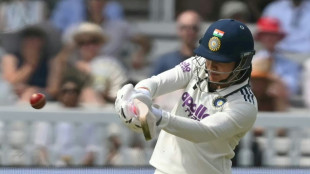 India's Mandhana stars in inaugural women's Test at Lord's

 Xhaka tells Swiss fans to 'keep dreaming' ahead of Argentina World Cup clash

"Get down to the floor! The party begins!" Shouting in English, Jan-Erik Olsson walked into a Stockholm bank on August 23, 1973, high on drugs, agitated and waving a submachine gun.
So began a hostage drama that would go on to last six days, and birth the term "Stockholm Syndrome" -- a concept now known around the world whereby captives develop an emotional bond with their captors.
Olsson, known by his nickname "Janne", took four employees hostage -- three women and one man.
Police and media quickly swarmed the square outside Kreditbanken, with snipers perched in surrounding buildings, their weapons pointed at the bank.
Olsson used two hostages as human shields and threatened to kill them.
"Afterwards, I've often thought of the absurd situation we found ourselves in," recalled hostage Kristin Enmark, then 23, in her book "I Became the Stockholm Syndrome".
"Terrified and stuck between two death threats, on one side the police and on the other the robber."
- 'Feared for my life' -
Olsson made several demands, asking for three million kronor (almost $700,000 at the time), and that Clark Olofsson, one of the country's most notorious bank robbers in prison at the time, be brought to the bank.
To calm things down, the Swedish government agreed.
The entire country was mesmerised by the unfolding drama, one of the first major news events broadcast live on Swedish television.
"When Clark Olofsson arrived, he took control of the situation, he was the one who did the talking with the police," recalled now 73-year-old Bertil Ericsson, a news photographer who covered the crisis, in an interview with AFP.
"He had a lot of charisma. He was a good speaker."
Olsson calmed down as soon as Olofsson arrived. And Kristin Enmark quickly saw in Olofsson a saviour.
"He promised that he would make sure nothing happened to me and I decided to believe him," she wrote.
"I was 23 years old and feared for my life."
She spoke on the phone to authorities several times during the hostage drama, shocking the world when she came out in defence of her captors.
"I'm not the least bit afraid of Clark and the other guy, I'm afraid of the police. Do you understand? I trust them completely," she told then prime minister Olof Palme in one phone call.
"Believe it or not but we've had a really nice time here," she said, adding that they were "telling stories" and "playing checkers".
"You know what I'm afraid of? That the police will do something to us, storm the bank or something."
The crisis ended on the sixth day when police sprayed gas into the bank, forcing Olsson and Olofsson to surrender, and freeing the hostages.
- 'Not a psychiatric diagnosis' -
Psychiatrist Nils Bejerot was a member of the negotiating team.
His job was to analyse the robbers' and hostages' behaviour, and he ultimately coined the term "Stockholm Syndrome".
At the time, the women were believed to be behaving as if under a spell, similar to being brainwashed.
Psychiatrists have since dismissed that notion.
Stockholm Syndrome is "not a psychiatric diagnosis", says Christoffer Rahm, a psychiatrist at the Karolinska Institute and author of the scientific article "Stockholm Syndrome: Psychiatric Diagnosis or Urban Myth?".
Rather, the term is used to describe a "defence mechanism that helps the victim" cope with a traumatic situation, he told AFP.
Cecilia Ase, gender studies professor at Stockholm University, said the statements by Enmark and the other women during the drama were interpreted by authorities "in a very sexualised dimension, as if they had fallen under the spell of a syndrome" and had lost all agency or ability to reason for themselves.
This perception was fuelled by rumours of a relationship between Enmark and Olofsson.
While the two did go on to have a love affair years later, there is nothing to suggest the two had a relationship in the bank vault.
"There was no love or physical attraction from my side. He was my chance for survival and he protected me from Janne," wrote Enmark, the inspiration for the character "Kicki" in the Netflix series "Clark".
Ase argues that Stockholm Syndrome is a "constructed concept" used to explain how hostages behave when authorities and states fail to protect them.
The Stockholm hostages in fact "acted incredibly rationally", she told AFP.
"They called journalists, they fought (with police and politicians) to let the criminals take them out of the bank."
"We represented a real threat to the hostages," acknowledged police superintendent Eric Ronnegard in a book published years later.
"With so many police officers surrounding the bank, there was a risk that one of the hostages could take a bullet."
In a sign of their bitterness toward police, the hostages later refused to testify against their captors.
Most people can identify with the concept on a psychological level, Rahm said, noting that emotional bonds with someone posing a threat are also common in abusive relationships.
Understanding a victim's psychological reaction also helps relieve them of their guilt, he said.
A.Clark--AT