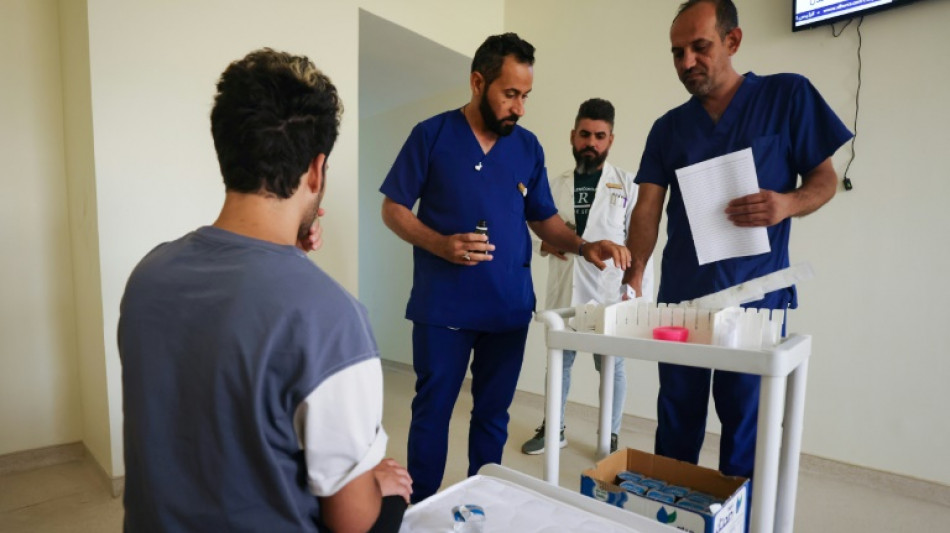
Battling drug crisis, Iraq searches for cure / Photo: Ahmad AL-RUBAYE - AFP

 From obscurity to smashing sixes: Pakistan's Razaullah rises to stardom
 Bezzecchi takes pole for San Marino MotoGP
 China, Russia, Iran leaders gather in India as BRICS nations seek common ground

 Korda finally beaten as Europe grasp slender Solheim lead

 Zelensky says willing to meet Putin at G20 in Miami: interview

 Quebec Brokerage Qubit Insurance Announces New Data on Coverage Shortfalls as Rebuilding Costs Rise

 Trump asks Smithsonian to install George Washington statues, exhibition

 'A legend': Celine Dion poised for emotional comeback in Paris

 Europe eyes battle over 'pervert' AI glasses

 Philippine Muslim enclave trades bullets for election ballots

 Children in flood-hit Nepal grapple with loss, cling to hope

 Bhutan business bets on hazelnuts for farming future

 First bodies of Philippines ferry fire victims land as toll hits 35

 Gaza film, Malkovich drama vie for Venice top prize

 DR Congo school fire stampede death toll rises to 26: UNICEF

 Best Free Gold IRA Kits in 2026 Rankings Released By Experts

 Top seed Zverev holds off Khachanov to reach US Open final

 James McAvoy brings new film 'Faith' to Toronto fest

 Faultless Duplantis, hungry Ingebrigtsen shine at inaugural Ultimate

 Roblox to launch wallet to pay creators faster and will allow off-platform gaming

 Springboks wary of new-look All Blacks in Baltimore test

 Townsend, Siniakova win US Open doubles for career Grand Slam together

 Verstappen unimpressed with new Madrid street track

 Razaullah heroics deny England quickfire win in 3rd Test against Pakistan

 Masks banned at planned UK protests: police

Mohammed has been taking nearly a dozen captagon pills daily for seven years. Now, as Iraq grapples with a major drug crisis, the 23-year-old hopes for a fresh start.
Iraq, which borders with Iran, Syria and Saudi Arabia, has long been a transit country for the region's ballooning trade in the amphetamine-type drug and other narcotics.
But in recent years, Iraq itself has witnesses a dramatic spike in drug abuse, prompting authorities to search for answers, both by cracking down on traffickers and by providing help to addicts.
Methamphetamine, or crystal meth, originating in Afghanistan or Iran, is among the most common drugs in Iraq today, alongside captagon, which is produced on an industrial scale in Syria and trafficked via Iraq to Saudi Arabia and other oil-rich Gulf states where it has gained notorious popularity.
Mohammed, who asked to use a pseudonym, is one of about 40 patients being treated at a rehabilitation clinic which the Iraqi health ministry opened in the capital Baghdad in April.
The young man, from the western Al-Anbar province on the border with Syria, told AFP he had been introduced to captagon, also known as "zero-one", by his work colleagues at a food store.
"It makes you active, gives you energy and keeps you awake," he said of the drug.
Since age 16, Mohammed would take "10 to 12" captagon pills a day, he confessed. Selling for the equivalent of $2 apiece, the stimulant "is everywhere".
Like the other patients at Al-Canal Centre for Social Rehabilitation, he came to the clinic on his own initiative.
After an initial two-week stay, he returned home, but then quickly headed back to the clinic, fearing a relapse.
Captagon, Mohammed said, "leads you either to prison or to death".
- 'Plague' -
Around him, in the laid-back atmosphere of the rehab centre gym, men of nearly all ages were playing table tennis and foosball, some of them smiling. Others were visibly tired or had blank expressions on their faces.
Patients usually stay for around one month at the facility, which also includes a women's wing and offers psychological support. Once discharged, they return for weekly check-ups for a period of six months.
"We host all ages. It starts at 14-15, but most are in their 20s," said the clinic's director, Abdel Karim Sadeq Karim.
The most common substance abuse the facility treats is crystal meth. "From the very first dose, there's addiction," said Karim.
His deputy, Ali Abdullah, called it "a plague that totally destroys individuals", noting a hike in drug consumption in Iraq since 2016.
Iraqi security forces now announce near-daily drug busts and arrests, in operations supported by intelligence and cooperation with neighbouring countries.
Hussein al-Tamimi, spokesman for Iraq's narcotics directorate, told AFP that authorities had detained more than 10,000 suspects between October and June for "crimes related to narcotics -- traffickers, resellers or consumers".
According to the government agency, security forces also seized 10 million captagon pills and 500 kilograms (1,100 pounds) of other drugs including at least 385 kilograms of crystal meth.
A regional meeting hosted by Baghdad in May saw "the creation of a shared database" to exchange information between authorities across borders, said Tamimi.
That meeting also led to "the establishment of weekly contacts between our services and the competent services of Arab states" and of other countries in the region, he added.
- Market transformation -
According to an AFP tally based on official records, at least 110 million captagon pills have been seized across the Middle East this year.
In mid-July, Iraq's interior ministry announced the discovery of a rare captagon manufacturing lab in the country's south.
It was the first such announcement in a country where drug production remains virtually nonexistent.
A Western diplomat stationed in Baghdad told AFP that Iraq's emerging importance for captagon trafficking may be attributed in part to a crackdown in neighbouring Jordan.
Amman has reinforced its borders in a bid to cut off trade routes via its territory and set up a forum to tackle smuggling from Syria, while Jordanian security forces often open fire at suspected drug traffickers.
Until about seven years ago, Iraq had been almost exclusively a transit country, but that has gradually changed as drugs can also replace payment for rights of passage, said the diplomat, requesting anonymity.
The domestic resale that resulted has generated local consumption and "potentially... a real market", the diplomat added, noting the high proportion of young people among Iraq's 43-million-strong population.
Recognising the risks, the government has opened three rehabilitation centres -- in Al-Anbar province, Kirkuk in the north and Najaf in central Iraq -- with plans to expand the scheme to other provinces.
Their aim is to give addicts who have been arrested a place to recover, away from traffickers in prison.
E.Rodriguez--AT