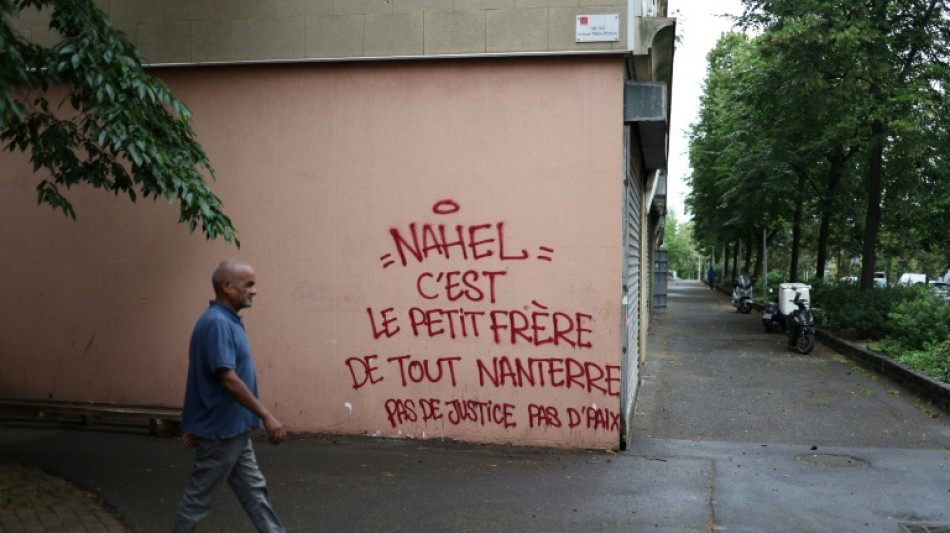
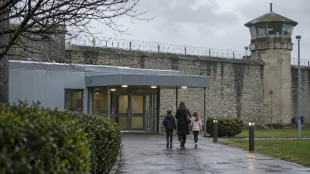
Death of Nahel brings old problems in France's suburbs back to the surface / Photo: CHARLY TRIBALLEAU - AFP/File

 Breytenbach confirms recommending Sibiya for Johannesburg post

 Celebrities mark Thanksgiving in turkey-themed photo gallery

 German fashion model Veruschka dies in Berlin at 87
 Thanksgiving storms disrupt thousands of US flights
 T.J. Lang criticises Aaron Rodgers over comments about Mike McCarthy

 Black Friday beauty offers span skincare, fragrance and wellness devices

 U2 pays tribute to Dolly Parton during Thanksgiving Eve NFL show

 Toyota Innova Hycross and Kia Sorento hybrids compared in top trims

 President Trump to Attend TSMC Groundbreaking in Phoenix Next Week

 Gauteng Health Department Warns of Rising Antibiotic Resistance Threat

 Bishop Museum Races to Save Rare Megamouth Shark Specimen

The death of French teenager Nahel M., killed by a police officer during a traffic stop a week ago, has reignited the anger of young people and brought deeper problems back to the surface, according to residents of Paris's working-class suburbs.
In the Paris suburb of Nanterre, on the streets of the Pablo Picasso housing estate where Nahel was from, nights of riots since the shooting last Tuesday have left behind the carcasses of burnt-out cars, melted garbage bins and countless graffiti tags calling for "Justice for Nahel".
"There's a feeling we're fed up with it, we've seen it all before. Of course I understand that, I also grew up here. That said, burning down schools and shops is crazy because it harms us all," said Mohamed, 39.
Sitting on a bench in a park, he said he came down from his home several nights in a row to "reason with the kids".
Next to him, his friend Sofiane, 38, sighed, pointing to the ash-grey skeleton of a merry-go-round that was torched Thursday evening.
"Damage we don't tolerate. What we don't really want anymore are random (police) checks. We want them to check us as if we were called 'Michel'," he said, adding he was "distressed" by the death of a "kid" during a traffic stop.
Living in one of the tower blocks behind the park, Fatiha Abdouni, 52, also came down from her building Saturday evening to meet with neighbourhood mediators as another night of unrest loomed.
"I can't support people smashing and burning things; who would?" said Abdouni, co-founder of the association The Voice of the Women of Pablo-Picasso.
Still, she added: "Now we have to listen to the young people, their frustration and anger."
Youths in Paris's deprived suburbs face "daily difficulties, unequal access to study, to work, to housing", Abdouni continued.
For her, it was obvious -- the death of Nahel was a "spark" reigniting "deeper problems".
- 'Give hope to our children' -
Since Nahel's death, the riots have been led by "very young people", moving in small groups and relaying their actions on social networks. On Thursday night, the average age of those arrested was just 17, according to Interior Minister Gerald Darmanin.
Justice Minister Eric Dupond-Moretti on Saturday felt it was necessary "to tell parents again that they should keep hold of their kids".
"It is not by pointing the finger at the parents as if they were irresponsible that we will make things move forward," said Mohamed Mechmache, coordinator of an association set up in Clichy-sous-Bois after the 2005 riots in the low-income eastern suburb of Paris.
That unrest was triggered by the deaths of two teenagers from Malian and North African backgrounds who were electrocuted while hiding from a police check in a relay station.
"It is time to speak publicly to the youth, to tell them that they are part of this Republic," the educator told AFP.
"The most important thing is to give hope to our children, that they believe in their future. I am afraid that there will be another death," added political scientist Fatima Ouassak, co-founder of the Front de Meres (Mothers' Front), an organisation of parents of students from working-class areas.
At the Pablo-Picasso estate, none of the young people met by AFP on Sunday wanted to speak.
During a protest march in tribute to Nahel on Thursday, a 16-year-old boy said: "It's always the same people who are targeted, blacks and Arabs, working-class neighbourhoods. They kill a 17-year-old boy like that, for nothing; this death makes us hate."
After five nights of riots, Nahel's grandmother Nadia appealed for calm on Sunday.
"I tell the people who are rioting this: Do not smash windows, attack schools or buses. Stop! It's the mums who are taking the bus, it's the mums who walk outside," she said.
Mohamed and Sofiane, who said they were pleased with the return to relative calm, now hope that "justice will be done".
"This policeman is a human being, he must be a defendant like you and me. No two-tier justice."
P.Smith--AT