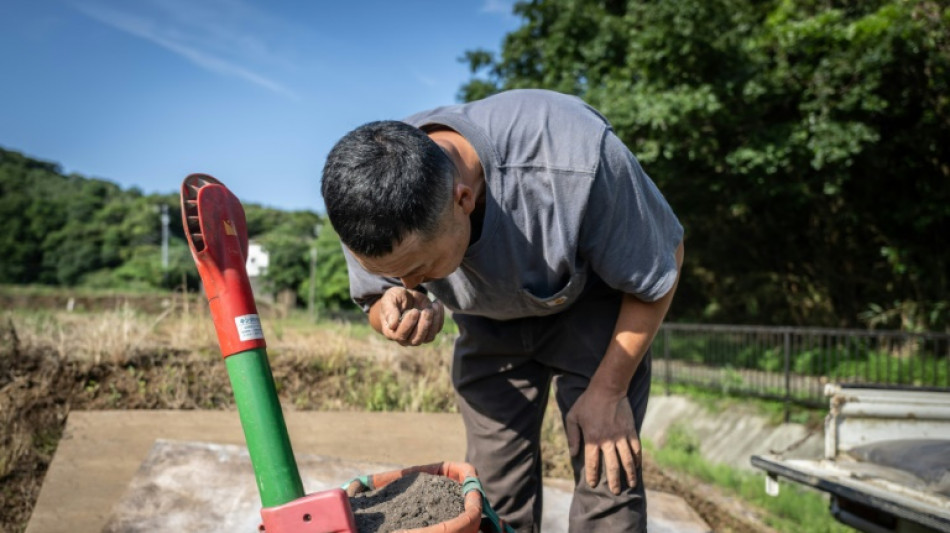
As prices soar, Japan returns to human waste fertiliser / Photo: Yuichi YAMAZAKI - AFP

 Mas on brink of Vuelta triumph as Landa claims stage 20

 No Kerr clash as Ingebrigtsen pulls out of Ultimate 1,500m

 Anthropic boss calls for slowing pace of AI development

 BRICS nations call for 'maximum restraint' in Middle East war

 England v Pakistan Test series: Three talking points

 Marquez snatches San Marino MotoGP sprint ahead of Bezzecchi

 Philippine ferry fire death toll climbs to 76 as identification process begins

 BRICS nations urge 'maximum restraint' in Middle East war

 Zelensky open to meeting Putin at G20 in Miami

 England survive scare to seal 3-0 sweep against Pakistan

 Trump says Irish unification would be 'fantastic'

 Bodies of Philippines ferry fire victims brought ashore as toll hits 35

 Flick warns Barca stars to keep focus after perfect start

 Trump in Ireland for golf tournament, diplomatic pleasantries

 French police suspect train derailment was sabotage

 Trump lands in Ireland for golf tournament, PM talks

 Xi lands in India for BRICS summit overshadowed by war

 From crime to the Arctic: ultramarathoner film debuts in Toronto

 Back to the drawing board for disappointed Tiafoe

 Lady Gaga welcomes first child with fiance: US media

 Shelton tops Tiafoe to book US Open title clash with Zverev

 Shelton powers past Tiafoe to book US Open title clash with Zverev

 Venice Film Festival: A look back on the highlights

 'Widow's Bay' and 'The Pitt' are favorites for Emmys night

 'Everything different' as Zverev returns to US Open final

It's cheap, recycled, and has centuries of tradition: "shimogoe" or "fertiliser from a person's bottom" is finding new favour in Japan as Ukraine's war hikes the price of chemical alternatives.
As in several parts of the world, the use of "night soil" to fertilise crops was once common in Japan.
However, the advent of sewage systems and treatment facilities, as well as chemical fertilisers, saw it fall out of fashion.
About a decade ago, Japanese treatment facilities wondered if they could revive interest to avoid sewage sludge disposal -- a costly and potentially environmentally damaging process.
But enthusiasm was limited until Russia's invasion of Ukraine sent the cost of chemical fertilisers soaring.
That has been a bonanza for a facility in northern Japan's Tome, where sales of shimogoe were up 160 percent year-on-year by March 2023.
For the first time since the city began producing the fertiliser in 2010, it has sold out.
The demand is easy to explain, said facility vice president Toshiaki Kato.
"Our fertiliser is popular because it is cheap, and it is helping farmers cut soaring costs," he told AFP.
"It is also good for the environment."
Made of a combination of treated sewage sludge from septic tanks and human waste from cesspits, the fertiliser goes for 160 yen ($1.10) per 15 kilos.
That's about a tenth of the price of products made from imported raw materials.
In southwestern Japan's Saga too, officials report sales are up two to three times.
And dozens of tour groups from municipalities elsewhere in the country have visited, eager to replicate their programme.
- Historic origins -
Shimogoe was a key fertiliser in Japan's pre-modern Edo era, said Arata Kobayashi, a fertiliser specialist who has written journal articles on the subject.
In the early 18th century, the one million residents of Tokyo -- then called Edo -- "produced" an estimated 500,000 tonnes of fertiliser a year.
It was big business, involving gatherers, transporters and farmers, "and all of them benefited from the recycling system," Kobayashi said.
They "didn't create a recycling system on purpose... it was the result of everyone pursuing profit."
Japan's government has encouraged the revival, citing environmental benefits, and concerns about food security since Russia's invasion.
The ministry of agriculture, forestry, and fisheries hopes to double animal manure and human waste use by 2030, with a goal of them accounting for 40 percent of all fertiliser use in Japan.
In Miura outside Tokyo, vacuum trucks carrying human waste arrive one after another at a treatment facility.
Water is removed and then bacteria ferment the remaining solids in huge tanks.
Methane produced during the process is burned to supply the facility's hot water and electricity, and the final product is a soil-like powder that can be spread on fields.
"We produce 500 tonnes of fertiliser annually," said Kenichi Ryose, facility manager at Miura Biomass Centre.
"This fertiliser is particularly good for leaf vegetables, like cabbage," he added.
Ryose said "harmful materials like heavy metals are removed from processed sewage sludge before arriving" at the plant.
In the United States, there have been recent concerns about the levels of so-called forever chemicals (PFAS) in fertiliser made from sewage.
An environment ministry official said similar concerns had not been reported in Japan, but noted there are no current guidelines for PFAS levels in soil.
"We're in the process of developing a scientifically reliable way to measure PFAS and studying how to regulate it," he said, speaking on condition of anonymity.
- 'Dirty mud' -
The sun is shining as the trucks arrive, and despite the facility's odour-absorbing machines, a distinct aroma fills the air.
The smell has proved something of a problem, admitted Nobuyoshi Fujiwara, 41, who runs a lettuce farm in Yokosuka, north of Miura.
He started using shimogoe last year, "because I wanted to cut costs, and for the social good" of recycling waste.
But "we can't use it in fields near houses, because there are complaints about the smell".
"Also, you have to spread four or five times the volume that you use with regular chemical fertilisers," he explained.
That's the case for any type of manure, but can be a turn-off for some farmers because it is more work.
He concedes that the fertiliser faces something of a branding issue.
"The Chinese characters that are used for sludge -- 'dirty mud' -- are not great," he said.
"Even though we produce safe food, I imagine that for those who don't know much about it, the impressions people have of fertiliser made from human faeces might not be good."
He doesn't want to hide his use of the fertiliser though. In fact, he would like to see it publicised.
"An official certification system would be helpful to promote our produce," he said.
P.A.Mendoza--AT