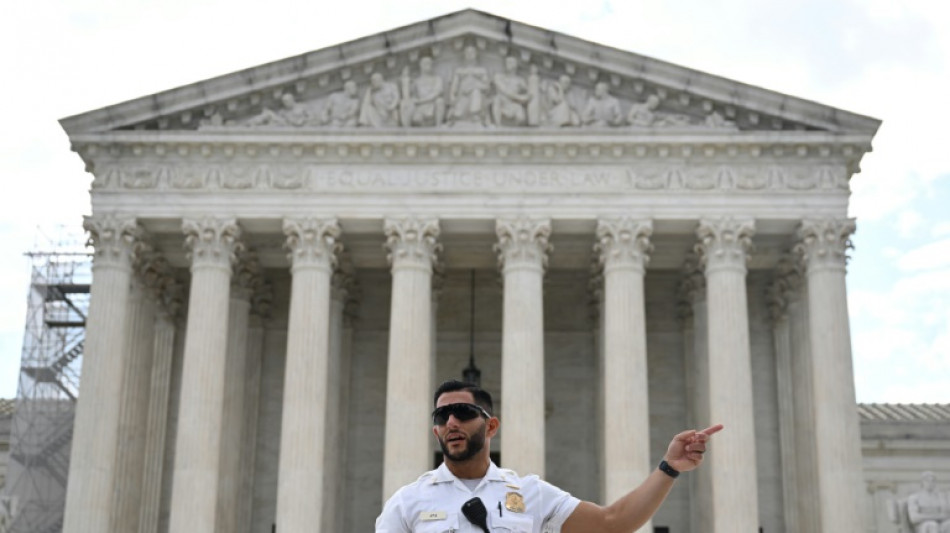
US Supreme Court bans the use of race in university admissions / Photo: Jim WATSON - AFP

 Mas on brink of Vuelta triumph as Landa claims stage 20

 No Kerr clash as Ingebrigtsen pulls out of Ultimate 1,500m

 Anthropic boss calls for slowing pace of AI development

 BRICS nations call for 'maximum restraint' in Middle East war

 England v Pakistan Test series: Three talking points

 Marquez snatches San Marino MotoGP sprint ahead of Bezzecchi

 Philippine ferry fire death toll climbs to 76 as identification process begins

 BRICS nations urge 'maximum restraint' in Middle East war

 Zelensky open to meeting Putin at G20 in Miami

 England survive scare to seal 3-0 sweep against Pakistan

 Trump says Irish unification would be 'fantastic'

 Bodies of Philippines ferry fire victims brought ashore as toll hits 35

 Flick warns Barca stars to keep focus after perfect start

 Trump in Ireland for golf tournament, diplomatic pleasantries

 French police suspect train derailment was sabotage

 Trump lands in Ireland for golf tournament, PM talks

 Xi lands in India for BRICS summit overshadowed by war

 From crime to the Arctic: ultramarathoner film debuts in Toronto

 Back to the drawing board for disappointed Tiafoe

 Lady Gaga welcomes first child with fiance: US media

 Shelton tops Tiafoe to book US Open title clash with Zverev

 Shelton powers past Tiafoe to book US Open title clash with Zverev

 Venice Film Festival: A look back on the highlights

 'Widow's Bay' and 'The Pitt' are favorites for Emmys night

 'Everything different' as Zverev returns to US Open final

The US Supreme Court on Thursday banned the use of race and ethnicity in university admissions, dealing a major blow to a decades-old practice that boosted educational opportunities for African-Americans and other minorities.
"The student must be treated based on his or her experiences as an individual -- not on the basis of race," Chief Justice John Roberts wrote in the majority opinion.
The justices broke six to three along conservative-liberal lines in the decision, which came after years of conservative antipathy to "affirmative action" policies that have sought diversity in school admissions and business and government hiring.
The court said that universities were free to consider an individual applicant's personal experience -- whether, for example, they grew up experiencing racism -- in weighing their application over applicants more academically qualified.
But deciding primarily based on whether the applicant is white, Black or other is itself racial discrimination, Roberts wrote.
"Our constitutional history does not tolerate that choice," he said.
The court sided with an activist group, Students for Fair Admissions, that sued the oldest private and public institutions of higher education in the country -- elite Harvard University and the University of North Carolina (UNC) -- over their admissions policies.
The group claimed that race-conscious admissions policies discriminated against equally or better-qualified Asian Americans competing to enter the two universities.
Harvard and UNC, like a number of other competitive US schools, consider an applicant's race or ethnicity as a factor to ensure a diverse student body and representation of minorities.
Such affirmative action policies arose from the Civil Rights Movement in the 1960s aiming to help address the legacy of discrimination in higher education against African Americans.
Thursday's ruling was a victory for conservatives, some who have argued that affirmative action is fundamentally unfair.
Others have said the policy has outlived its need because educational opportunities have vastly improved for Blacks and other minorities.
But the ruling was a major setback to progressives, one year after the court overturned the landmark 1973 "Roe v. Wade" decision guaranteeing a woman's right to abortion.
The end to federally guaranteed abortion rights almost immediately led to half of the 50 states banning or severely curtailing the practice.
The affirmative action ruling could have the same effect of many states and institutions halting programs designed to give disadvantaged minorities extra consideration in the competitive college admissions process.
Leading the dissenters, Justice Sonia Sotomayor said the decision "rolls back decades of precedent and momentous progress."
"In so holding, the Court cements a superficial rule of colorblindness as a constitutional principle in an endemically segregated society," she wrote.
A.Ruiz--AT