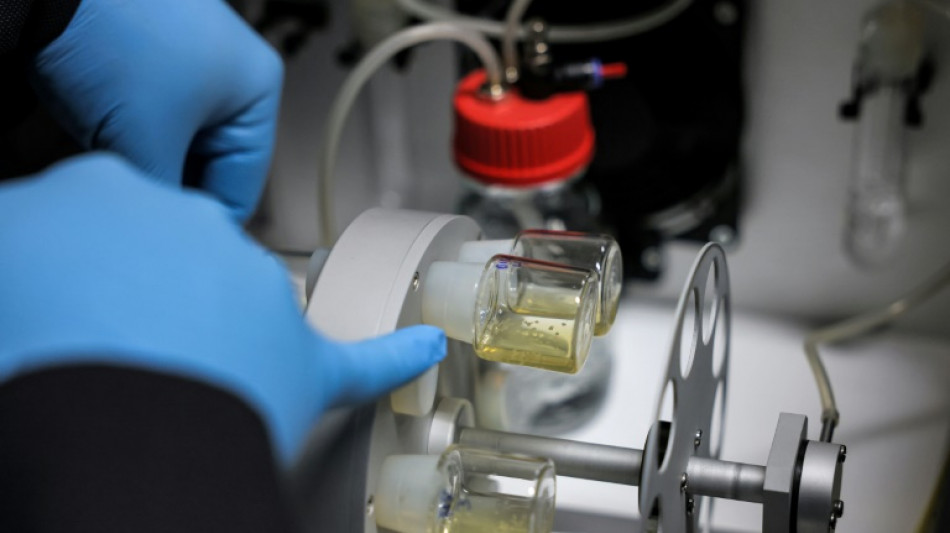
Lab-grown human embryo models spark calls for regulation / Photo: AHMAD GHARABLI - AFP/File

 De Zerbi apologises to fans after Spurs' stalemate extends goal drought
 Lowry takes four-shot lead as Trump jets in for Irish Open

 Harrison, Skupski win US Open men's doubles title

 Verstappen fears overtaking will be 'tough' at Spanish GP

 Argentina revives plan for South Atlantic naval base amid Falklands tensions

 Yemen government forces say hit Houthis in Red Sea city

 Dismal Spurs stay goalless after Everton stalemate

 Fire at nursing home in Chile kills 16

 Frustrated Hamilton urges Ferrari to 'work harder'

 Zelensky ready to meet Putin at Miami G20 but Kremlin refuses
 Anthropic boss calls for AI slowdown, Altman and Musk agree

 England back on track after 'chaos', says Root

 Shelton chases history in US Open title tilt with top seed Zverev

 Norris 'masterpiece' snatches Spanish GP pole from Antonelli

 Mas on brink of Vuelta triumph as Landa claims stage 20

 No Kerr clash as Ingebrigtsen pulls out of Ultimate 1,500m

 Anthropic boss calls for slowing pace of AI development

 BRICS nations call for 'maximum restraint' in Middle East war

 England v Pakistan Test series: Three talking points

 Marquez snatches San Marino MotoGP sprint ahead of Bezzecchi
 Philippine ferry fire death toll climbs to 76 as identification process begins
 BRICS nations urge 'maximum restraint' in Middle East war

 Zelensky open to meeting Putin at G20 in Miami

 England survive scare to seal 3-0 sweep against Pakistan

 Trump says Irish unification would be 'fantastic'

Scientists have used stem cells to create structures that resemble human embryos in the lab, in a first that has prompted calls for stricter regulation in the rapidly advancing field.
Several different labs around the world have released pre-print studies in the past seven days describing their research, which experts said should be treated with caution as the research has not yet been peer-reviewed.
The labs used different techniques to encourage human embryonic stem cells, which can become any type of cell, to self-assemble into a structure that resembles an embryo -- without needing sperm, an egg or fertilisation.
The aim is to give scientists a model with which to study human embryos in ways never before possible because of ethical concerns, in the hopes of gaining new insight into the causes of birth defects, genetic disorders, infertility and other problems during pregnancy.
The first announcement was last Wednesday, when Magdalena Zernicka-Goetz of Cambridge University and the California Institute of Technology described her team's work at the International Society for Stem Cell Research's annual meeting in Boston.
Her presentation was first reported by The Guardian newspaper.
On Thursday, the team of Jacob Hanna at the Weizmann Institute of Science in Israel published a pre-print study detailing their own work on stem cell-based human embryo models.
The Zernicka-Goetz team then quickly published a pre-print of their own, giving more information. Other labs based in China and the United States followed suit, releasing pre-prints late last week.
Researchers have pushed back against media reports calling the clumps of cells "synthetic embryos," saying that they are neither strictly synthetic, having grown from stem cells, nor should they be considered embryos.
- 'Almost uncanny' -
The flurry of data has highlighted the highly competitive nature of research in this field.
Within a few weeks of each other in August last year, both the Zernicka-Goetz and Hanna teams published papers about their work creating the first embryo-like structures using stem cells from mice.
Both teams told AFP that their new studies had been accepted by prestigious peer-reviewed journals -- and that they had presented their work at conferences months before the recent media attention.
Hanna rejected the idea that either team was "first", saying they had achieved quite different feats.
He told AFP that his models had a "placenta, a yolk sac, amniotic cavity" and other embryo features that he said the Zernicka-Goetz structures lacked.
Other researchers seemed to agree that Hanna's models were more advanced, also praising his team for using only chemical and not genetic modifications to coax the cells into embryo-like structures.
"The similarity (of Hanna's model) to the natural embryo is remarkable, almost uncanny," said Jesse Veenvliet, a researcher at Germany's Max Planck Institute of Molecular Cell Biology and Genetics.
Darius Widera, an expert in stem cell biology at the UK's University of Reading, told AFP that it was best to wait for peer review before comparing the research.
But "the impact of both studies is immense", he added.
"We should try to avoid unhealthy hype since this technology is at an early stage -- but already, new guidelines are going to be needed."
- Inside the 'black box'? -
Both labs said they had developed their embryo models for 14 days, the legal limit for growing human embryos in the lab in many countries.
After 14 days embryos start organising cells to form organs including the brain, a period called the "black box" because little is known about human embryos beyond that point.
Regulations for research in this area differ between countries but most apply to embryos that have been fertilised -- a loophole the new embryo-like models slip through.
Cambridge University said on Friday it had launched a project to develop the first governance framework for stem cell-based human embryo models in the UK.
The scientists involved have emphasised that they are not intending to implant their embryo models into a human womb -- and that even if this was done, it would not lead to a baby.
An embryo model implanted in a female macaque as part of earlier research did induce some signs of pregnancy, but did not survive, Widera said.
James Briscoe of Britain's Francis Crick Institute called for researchers to "proceed cautiously, carefully and transparently".
"The danger is that missteps or unjustified claims will have a chilling effect on the public and policymakers, this would be a major setback for the field."
M.O.Allen--AT