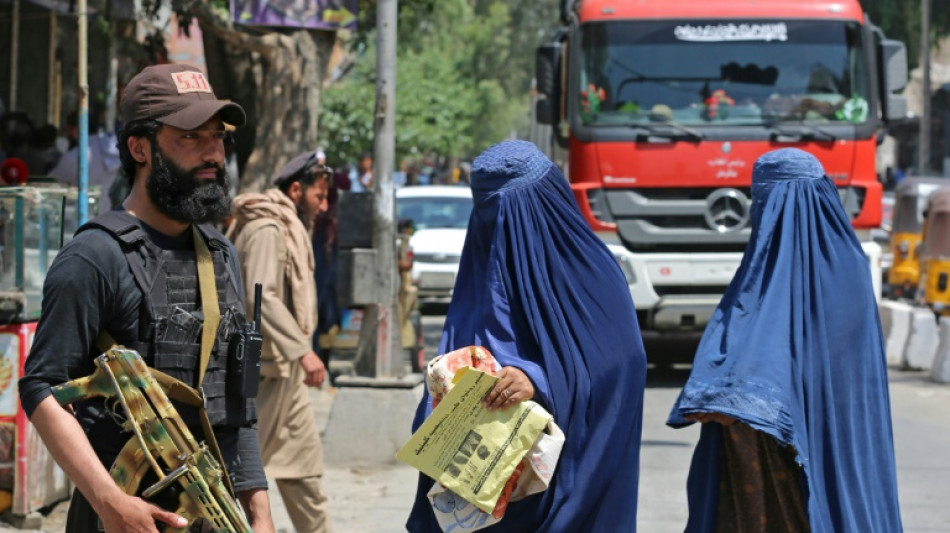
Afghanistan's 'gender apartheid' should be international crime: UN expert / Photo: Shafiullah KAKAR - AFP

 Breytenbach confirms recommending Sibiya for Johannesburg post
 Celebrities mark Thanksgiving in turkey-themed photo gallery

 German fashion model Veruschka dies in Berlin at 87

 Thanksgiving storms disrupt thousands of US flights
 T.J. Lang criticises Aaron Rodgers over comments about Mike McCarthy
 Black Friday beauty offers span skincare, fragrance and wellness devices

 U2 pays tribute to Dolly Parton during Thanksgiving Eve NFL show

 Toyota Innova Hycross and Kia Sorento hybrids compared in top trims

 President Trump to Attend TSMC Groundbreaking in Phoenix Next Week

 Gauteng Health Department Warns of Rising Antibiotic Resistance Threat

 Bishop Museum Races to Save Rare Megamouth Shark Specimen

The UN's top expert on rights in Afghanistan urged countries Monday to consider making "gender apartheid" an international crime, helping hold the Taliban accountable for its grave and systematic abuses against Afghan women.
Since ousting a foreign-backed government in August 2021, the Taliban authorities have imposed an austere sharia law, barring girls from secondary school, pushing women out of many government jobs, preventing them from travelling without a male relative and ordering them to cover up outside the home.
"It is imperative that we do not look away," Richard Bennett told the UN Human Rights Council.
Presenting his latest report, the UN special rapporteur on the situation in Afghanistan told the council that the Taliban's actions could constitute the crime against humanity of "gender persecution".
In addition, "grave, systematic and institutionalised discrimination against women and girls is at the heart of Taliban ideology and rule, which also gives rise to concerns that they may be responsible for gender apartheid", he said.
Such "serious human rights violations, which although not yet an explicit international crime, requires further study," he insisted.
Framing gender apartheid as an international crime would highlight that other countries and the broader international community "have a duty to take effective action to end the practice", the report said.
"Women often talk about being buried alive, breathing, but not being able to do much else without facing restrictions and punishments," said Shaharzad Akbar, the head of the Rawadari rights group and former head of the Afghanistan Independent Human Rights Commission.
"Taliban have turned Afghanistan to a mass graveyard of Afghan women and girls's ambitions, dreams and potential," she told the council.
The UN has already labelled the situation in Afghanistan under the Taliban as "gender-based apartheid", but the term is not currently recognised under the Rome Statute among the worst international crimes.
Bennett and others called Monday for countries to consider changing that.
Akbar backed the call, urging the council to "support the inclusion of gender apartheid in the Draft Convention on Crimes Against Humanity."
Bennett's report -- drafted jointly with the UN working group on discrimination against women and girls -- called on countries to "mandate a report on gender apartheid as an institutionalised system of discrimination, segregation, humiliation and exclusion of women and girls".
This should be done, the report said, "with a view to developing further normative standards and tools, galvanising international legal condemnation and action to end it and ensure its non-repetition".
A number of country representatives also voiced support for the idea Monday.
Among those was the South African representative Bronwen Levy, who urged the international community to "take action against what the report describes as gender apartheid, much like it did in support of South Africa's struggle against racial apartheid."
M.Robinson--AT