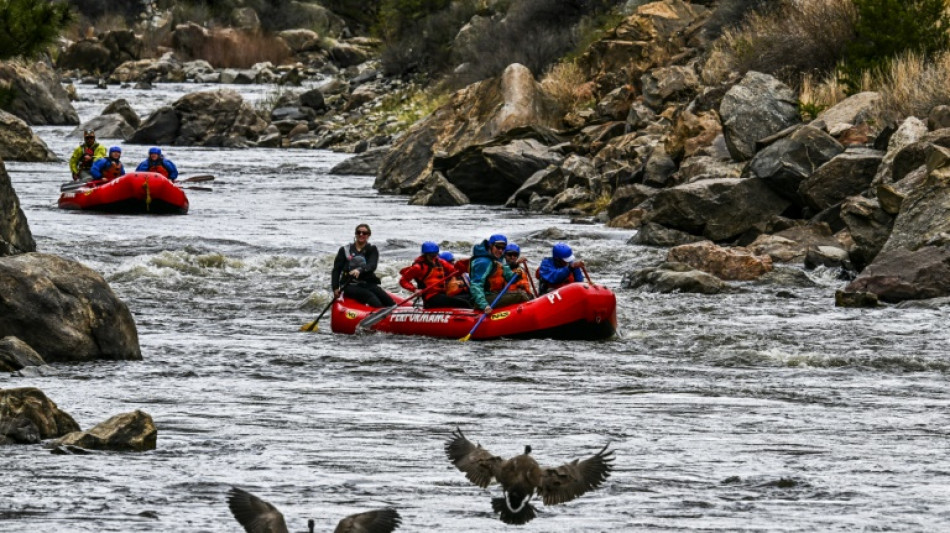
Healthy snowpack heralds bumper season for US rafters / Photo: CHANDAN KHANNA - AFP

 Arteta blasts 'unacceptable' Sunderland penalty despite Arsenal win

 Mbappe at the double as Real Madrid sink Rayo

 Arsenal extend perfect Premier League start as Chelsea, Liverpool held

 US survive Spain scare to book World Cup final clash with France

 Celine Dion makes long-awaited return to stage in Paris

 Werro crowned Ultimate queen, US sweep 100m races

 Venezuelans outside Caracas say capital not sharing blackout burden

 Danish WWII drama wins top prize at Venice festival
 Chelsea boss Alonso yearns for 'boring game' after Hull make their point

 Werro outguns Hodgkinson to win women's 800m at Ultimate

 Moreira leads AC Milan fightback in Lazio draw
 Chelsea boss Alonso for yearns for 'boring game' after Hull make their point

 'Tired' Liverpool must adapt to schedule, says Iraola

 Stunning US fightback sets up Solheim Cup singles showdown

 Monaco's perfect Ligue 1 start ends with Strasbourg draw

 Ukraine's economy hobbled by Russian strikes

 France sink Germany to reach first women's basketball World Cup final

 Hull hold Chelsea, Liverpool fail to beat Fulham in Premier League

 Nmecha and Silva keep Dortmund perfect in Bundesliga

 Norris snatches thrilling Spanish GP pole from Antonelli

 'Great to have a race at home': Fans celebrate F1's Madrid return

 French IT giant Capgemini sells subsidiary after row over ICE links

 Thousands rally in Kosovo ahead of ex-leader's war crimes verdict

 Zelensky ready to meet Putin at G20 in Miami
 Gaza film, 'irreverent' Malkovich drama vie for Venice top prize

A healthy Rocky Mountain snowpack looks set to offer a bumper season for thrill-seeking white water rafters on Colorado's rivers.
Operators plying waterways fed by the US mountain range say a decent winter and a slow snowmelt should offer months of fun for those intent on hurtling over bubbling rapids.
"This river has doubled in size... since three days ago," said Corey Coker, who has been leading rafting expeditions on the Arkansas River in Colorado for well over a decade.
"I believe today we're just under 1,000 cubic feet per second," he told AFP in mid-May.
One cubic foot is about 7.5 US gallons, or 28 liters.
That means if you drew a line across the river, there would be 7,500 gallons of water going past at any given moment.
"It doesn't look too bad here," he said as he pushed the raft into a wide, slow-flowing section of the river.
"But when you're down in the rapids, that water level makes a big difference to how scary things look."
Indeed, as the water narrows along a path carved out millennia ago, things really start to quicken.
What was once gently flowing and rather harmless-looking water takes on an angry foam-filled churn in the majestic Browns Canyon.
Coker shouts instructions to rafters to paddle backwards or forwards as they try to steer their inflatable vessel around or over the huge stones.
Each rapid plunges the front of the raft into the spume, spraying occupants with water cold enough to remind them it was snow just a few hours earlier.
For those brave enough -- or unlucky enough -- to take a plunge, even a wetsuit isn't enough to guard against the bone-chilling cold.
"This is a very good year for water, we have no concerns there," said Mark Hammer, who runs The Adventure Company in Buena Vista.
"It shouldn't be exceedingly high, and should provide us with a really long season."
- Wet winter -
Years of below-average snowfall across the US West have left river systems depleted, as a long-term aridification trend is exacerbated by human-caused planet warming.
Some of the main riverine arteries that criss-cross the country have been badly hit, with the once-mighty Colorado River dwindling.
The situation became so bad last year that Lake Mead, an enormous reservoir formed by the Hoover Dam, dropped to just a quarter of its capacity, threatening "deadpool" -- where the river downstream dries up, and hydro-electric generation grinds to a halt.
But a wet winter that left a thick blanket of snow over the Rocky Mountains, has -- for now at least -- breathed new life into the rivers.
Scientists who measure the snowpack -- a vital store of water for a huge swathe of the country -- say to the west of the continental divide, it's looking very healthy.
The National Oceanic and Atmospheric Administration is "seeing some really huge numbers" for snowmelt "forecasted to flow into reservoirs throughout the Upper Colorado River Basin" this summer, according to the organization's Paul Miller.
The eastern side of the divide did not see quite as much snow, but it was still abundant.
That's good news for rafters on the Arkansas River, which rises near Leadville, Colorado, and meanders 1,500 miles (2,400 kilometers) across the Great Plains, before it joins the Mississippi River.
Hammer, whose company guides up to 8,000 people down the river every year, says while this season is set to be a good one on the waterway, there are no guarantees for the future.
A changing climate, over-use by burgeoning population centers and voracious agriculture are all stressing these lifebloods.
"I would love to see people taking a more serious look at the overall water that's available," he told AFP.
"I don't hear a lot of great solutions. And I know it's a tough problem to solve, and it’s probably going to take decades to manage our water better. However, I don't think we have much of a choice."
T.Wright--AT