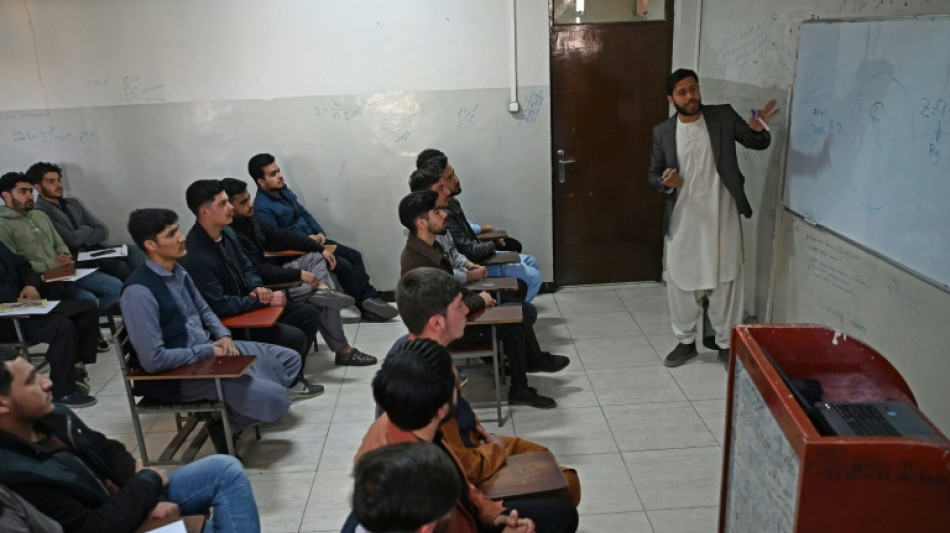
Women still barred as Afghan universities reopen for men / Photo: Wakil KOHSAR - AFP

 Gauteng Health Department Warns of Rising Antibiotic Resistance Threat

 Bishop Museum Races to Save Rare Megamouth Shark Specimen

 InterContinental Hotels Group PLC Announces Transaction in Own Shares - November 26

 Twickenham Grounds Team Prepares Pitch for Six Matches in Three Days

 Luxembourg Pay Rise Delayed as Regional and World Headlines Develop

 Audience to Choose the Set List at Luxembourg's First FAMIL Jukebox Night

 Raheem Sterling Receives Suspended Sentence After Lamborghini Crash

 Black Friday Discounts Cut Prices on Two Top-Rated Wiper Blades

 TCC Network Linked to 200% Surge in Global School Attacks
Afghan universities reopened on Monday after a winter break, but only men returned to class with a "heartbreaking" ban by the Taliban authorities on women in higher education still in force.
The university ban is one of several restrictions imposed on women since the Taliban stormed back to power in August 2021 and has sparked global outrage -- including across the Muslim world.
"It's heartbreaking to see boys going to the university while we have to stay at home," said Rahela, 22, from the central province of Ghor.
"This is gender discrimination against girls, because Islam allows us to pursue higher education. Nobody should stop us from learning."
The Taliban government imposed the ban after accusing women students of ignoring a strict dress code and a requirement to be accompanied by a male relative to and from campus.
Most universities had already introduced gender-segregated entrances and classrooms, as well as allowing women to be taught only by female professors or elderly men.
Ejatullah Nejati, an engineering student at Kabul University, Afghanistan's largest, said it was women's fundamental right to study.
"Even if they attend classes on separate days, it's not a problem. They have a right to education and that right should be given to them," he said as he entered the university campus.
- Government fear -
Waheeda Durrani, a journalism student in Herat until she was barred from university last year, said the Taliban government wanted women to remain uneducated.
"If Afghan girls and women get educated, they will never accept a government that exploits Islam and the Koran," she said.
"They will stand for their rights. That's the fear the government has."
At the capital's private Rana University, male students trickled back to classes on Monday.
"My sister, unfortunately, cannot come to the university. She is trying to study at home," said Ebratullah Rahimi, another journalism student.
Posters dating from before the ban showing how women needed to dress were still on display in the university corridors.
"I feel like a lesser human being," said Negah Khan, a university student from eastern Afghanistan.
"When you have dreams but are subjected to imprisonment within the four walls of your house and made to serve people like a servant, it is disappointing."
In an open letter, a group of women students urged male students and professors to "boycott" classes, one of the writers, Zahra Mandagar, told AFP.
"The Taliban group has invited only you to come to the classrooms ... this is against our common aspirations to build a progressive, self-sufficient, free and equal Afghanistan," the letter said.
- 'Crime of gender persecution' -
Several Taliban officials say the ban on women's education is temporary but, despite promises, they have failed to reopen secondary schools for girls, which have been closed for more than a year.
The authorities have wheeled out a litany of excuses for the closure, from a lack of funds to the time needed to remodel the syllabus along Islamic lines.
The reality, according to some Taliban officials, is that the ultra-conservative clerics advising Afghanistan's supreme leader Hibatullah Akhundzada are deeply sceptical of modern education for women.
Taliban authorities have effectively squeezed women out of public life since retaking power.
Women have been removed from many government jobs or are paid a fraction of their former salary to stay at home.
"The Taliban's intentional and calculated policy is to repudiate the human rights of women and girls and to erase them from public life," Richard Bennett, the UN special rapporteur on human rights in Afghanistan, said in a speech in Geneva on Monday.
"It may amount to the crime of gender persecution, for which the authorities can be held accountable."
The international community has made the right to education for women a sticking point in negotiations over aid and recognition of the Taliban government.
No country has officially recognised the Taliban as Afghanistan's legitimate rulers.
S.Jackson--AT
