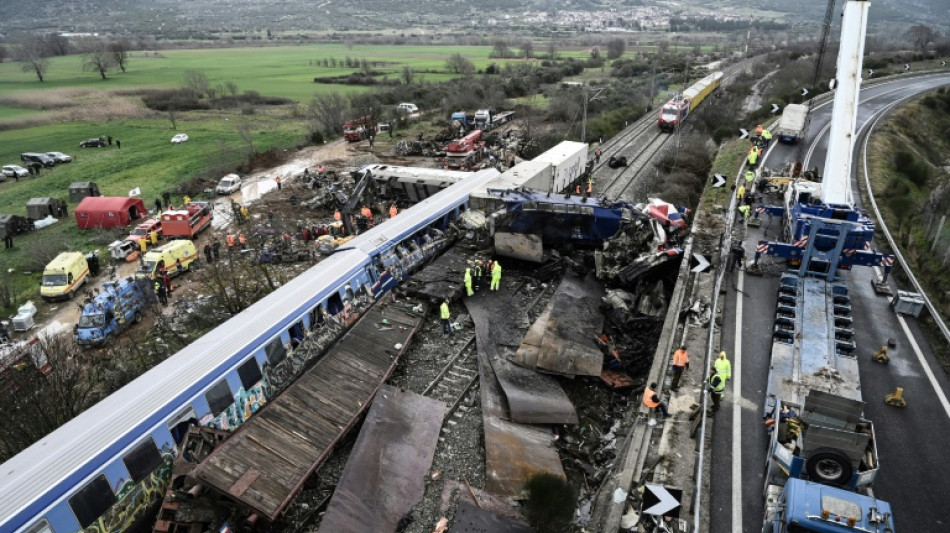
Police raid station over Greek train disaster / Photo: Sakis MITROLIDIS - AFP

 Gauteng Health Department Warns of Rising Antibiotic Resistance Threat

 Bishop Museum Races to Save Rare Megamouth Shark Specimen

 InterContinental Hotels Group PLC Announces Transaction in Own Shares - November 26

 Twickenham Grounds Team Prepares Pitch for Six Matches in Three Days

 Luxembourg Pay Rise Delayed as Regional and World Headlines Develop

 Audience to Choose the Set List at Luxembourg's First FAMIL Jukebox Night

 Raheem Sterling Receives Suspended Sentence After Lamborghini Crash

 Black Friday Discounts Cut Prices on Two Top-Rated Wiper Blades

 TCC Network Linked to 200% Surge in Global School Attacks
Greek police raided a train station Friday as part of their probe into the rail collision that killed at least 57 people, as the nation braced for new strikes and protests over the disaster.
Some families were still desperate to locate loved ones who were on the train and some demonstrations have turned violent as public anger builds over the role government mismanagement played in Greece's worst-ever rail accident.
A judicial source told AFP that files were among items seized by police on Friday during a raid on the Larissa train station in central Greece, where the fiery crash happened on Tuesday.
The passenger train -- carrying many students returning from a holiday weekend -- ran for several kilometres on the same track as an incoming freight train, reportedly after the station master in Larissa failed to reroute one of the trains.
The crash has sparked public criticism of government failures in the rail network, and protesters are expected to hold silent demonstrations Friday in the capital Athens and several major cities across Greece.
Unions have also urged railway workers to strike for a second consecutive day.
In Thessaloniki -- Greece's second largest city -- police said a protest of about 2,000 demonstrators turned violent on Thursday, with protesters throwing stones and petrol bombs.
Survivors described scenes of horror and chaos when the crash occurred, with many dodging smashed glass and debris as the train keeled over.
Some relatives were still desperately awaiting news of missing loved ones with fury and despair.
"No one can tell me anything -- if my child is injured or in intensive care or anything," one woman told AFP, desperately seeking news of her 23-year-old daughter Kalliopi.
Her 49-year-old husband Lazaros said he'd only discovered there had been a crash by watching the late evening TV news.
"I woke my wife up and asked her if our daughter was on that train. That was when the nightmare began," he said.
They said they have given DNA samples and are now waiting to find out if their daughter is alive.
Roubini Leontari, the chief coroner at Larissa's general hospital, told ERT on Thursday that over 10 people were still unaccounted for, including two Cyprus nationals.
- 'Lack of respect' -
Prime Minister Kyriakos Mitsotakis, who is seeking re-election this spring, said after visiting the crash site on Wednesday: "Everything shows that the drama was, sadly, mainly due to a tragic human error."
But Greece's train services were paralysed Thursday by striking workers who say that successive administrations' mismanagement of the network had contributed to the fatal collision.
The rail union federation denounced a "lack of respect towards Greece's rail network by successive governments over the years, which led to this tragic result".
Hundreds of angry demonstrators started rallying Wednesday in Athens, before being dispersed by police using tear gas, and some 700 protesters rallied outside the headquarters of rail operator Hellenic Train in the capital on Thursday.
"We are angry at the company, at the government and past governments that did nothing to improve conditions in the Greek railway," said pensioner Stavros Nantis.
- 'Complete evaluation' -
Train sector unions say security problems on the Athens-Thessaloniki railway line had been known for years.
The lawyer for the 59-year-old station master at Larissa -- who has been charged with negligent homicide -- said his client has admitted partial responsibility for the crash, but stressed there were other factors at play.
"My client has assumed his share of responsibility. But we must not focus on a tree when there is a forest behind it," lawyer Stefanos Pantzartzidis said on Thursday.
State broadcaster ERT has noted that the station master was only appointed to the post 40 days ago, after a training course that lasted just three months.
For decades, Greece's 2,552-kilometre (1,585-mile) rail network has been plagued by mismanagement, poor maintenance and obsolete equipment.
The country's transport minister resigned on Wednesday in the wake of the crash.
His replacement Giorgos Gerapetritis has vowed a "complete evaluation of the political system and the state".
Safety systems on the line are still not fully automated, five years after the state-owned Greek rail operator Trainose was privatised and sold to Italy's Ferrovie Dello Stato Italiane and became Hellenic Train.
Ch.Campbell--AT
