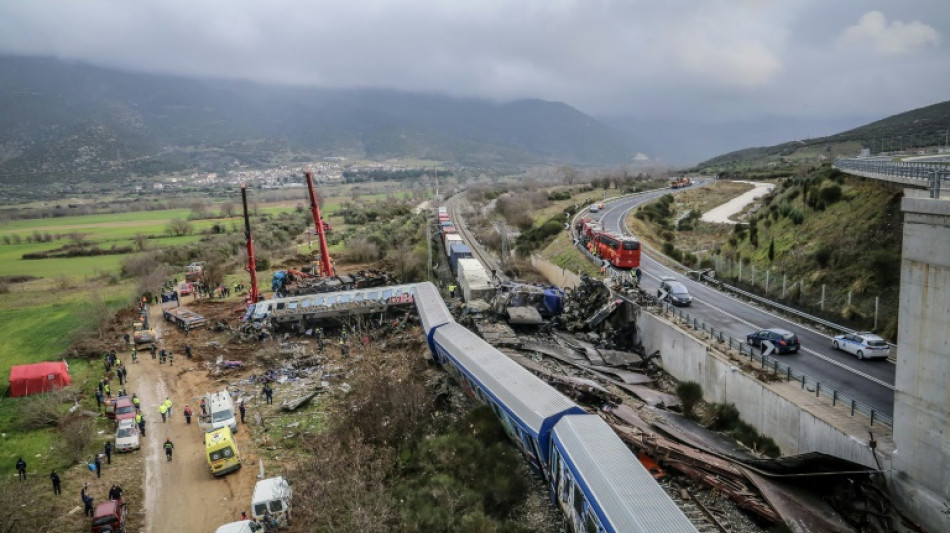
What we know about Greece's worst train tragedy / Photo: Zekas LEONIDAS - Eurokinissi/AFP

 Gauteng Health Department Warns of Rising Antibiotic Resistance Threat

 Bishop Museum Races to Save Rare Megamouth Shark Specimen

 InterContinental Hotels Group PLC Announces Transaction in Own Shares - November 26

 Twickenham Grounds Team Prepares Pitch for Six Matches in Three Days

 Luxembourg Pay Rise Delayed as Regional and World Headlines Develop

 Audience to Choose the Set List at Luxembourg's First FAMIL Jukebox Night

 Raheem Sterling Receives Suspended Sentence After Lamborghini Crash

 Black Friday Discounts Cut Prices on Two Top-Rated Wiper Blades

 TCC Network Linked to 200% Surge in Global School Attacks
Dozens of people were killed in Greece on Tuesday in a head-on collision of a freight train with a passenger train carrying over 350 people on board, the country's worst-ever rail disaster.
Here is what we know so far:
- How did it happen? -
The accident occurred at around 11:30 pm on Tuesday (2130 GMT) near Larissa in the Tempe Valley of Thessaly, central Greece, about 380 kilometres (236 miles) north of Athens, on the main railway line between the capital and Thessaloniki.
The passenger train, with 342 passengers and ten employees on board, slammed head-on into a freight train travelling on the same track in the opposite direction, officials said.
A fire broke out, apparently in the restaurant car that was among the three leading carriages. All ten train employees are believed to have died in the crash.
- Human toll -
At least 47 people have been confirmed dead by the fire department, but several more are known to have been trapped in the restaurant car and have yet to be extricated.
Most of the casualties were in the first three carriages, which included first-class seats.
Over 80 people were hurt. Most of the passengers were students returning to Thessaloniki after a long Carnival weekend.
- 'Apocalyptic' images -
Fire and rescue crews at the scene said they found "apocalyptic" scenes reminiscent of a war zone.
"Once we arrived at the scene of the disaster, our teams found themselves in an apocalyptic landscape," Yiannis Goulas, president of the union of emergency response workers (Ekav), told state broadcaster ERT on Wednesday.
"People covered in blood were running around asking for help. People strewn across the fields after being thrown out of broken windows," he added.
Images of the burned-out, mangled carriages at the front of the passenger train were broadcast live nonstop by media outlets. Two cranes were deployed to help pry apart the crumpled metal to search for survivors and bodies.
- Arrest and a resignation -
Hours after the crash, the Larissa station manager was arrested after giving a statement to police. The 59-year-old man is being prosecuted for negligent homicide and causing involuntary bodily harm. If convicted, he faces life in prison.
Prime Minister Kyriakos Mitsotakis said that "everything shows that the drama was, sadly, mainly due to a tragic human error", and Transport Minister Kostas Karamanlis resigned over the accident.
On Thursday, government spokesman Yiannis Economou said the station manager had "confessed" his responsibility for the accident.
"I believe the responsibility, the negligence, the error has been confessed by the station master," Economou said.
But he also admitted "delays" in installing safety safeguards on the route where the accident took place, a result of "chronic malaise and decades of failure" in state management.
- Anger over failures -
Greece's rail network, with a total 2,552 kilometres (1,585 miles) of track, has long been plagued by mismanagement, poor maintenance, obsolete equipment and service delays.
The head of the train drivers' union, Kostas Genidounias, said that trains were routed "manually, as the electronic (safety) systems have not worked since 2000".
In 2017, Greek state rail operator Trainose was acquired by the Italian public company Ferrovie Dello Stato Italiane (FS) and renamed Hellenic Train, part of a sweeping privatisation program mandated by Greece's creditors during the country's decade-long debt crisis.
Hellenic Train has been criticised for being unable to provide detailed information on the passengers, hampering the search and rescue operations.
In a statement Wednesday, the company said it was working closely with authorities and has offered "financial support" to the passengers.
T.Wright--AT
