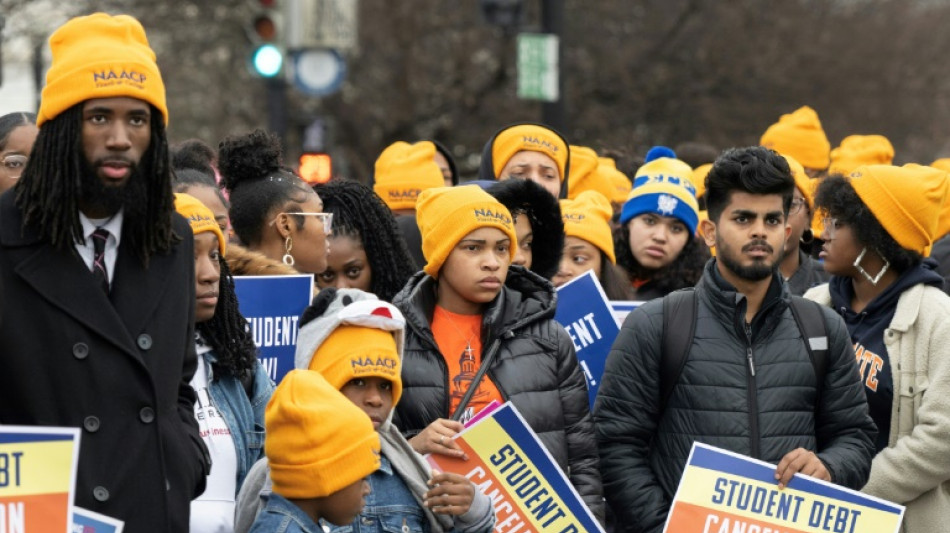
Biden's student debt relief plan challenged at Supreme Court / Photo: ANDREW CABALLERO-REYNOLDS - AFP

 Gauteng Health Department Warns of Rising Antibiotic Resistance Threat

 Bishop Museum Races to Save Rare Megamouth Shark Specimen

 InterContinental Hotels Group PLC Announces Transaction in Own Shares - November 26

 Twickenham Grounds Team Prepares Pitch for Six Matches in Three Days

 Luxembourg Pay Rise Delayed as Regional and World Headlines Develop

 Audience to Choose the Set List at Luxembourg's First FAMIL Jukebox Night

 Raheem Sterling Receives Suspended Sentence After Lamborghini Crash

 Black Friday Discounts Cut Prices on Two Top-Rated Wiper Blades

 TCC Network Linked to 200% Surge in Global School Attacks
The US Supreme Court heard arguments Tuesday in a challenge to President Joe Biden's plan to erase nearly $400 billion of student debt, with all eyes on how far the conservative-dominated bench is willing to go to override the Democratic leader.
The court's ruling, expected before June 30, will decide whether millions of Americans will see up to $20,000 of debt disappear, but could also have implications for future presidential actions.
About 200 protesters gathered outside the court, carrying signs backing Biden's policy.
Lamar Brooks, 22, an African American student from Baltimore, said he already had $18,000 of debt and expected the sum to rocket as he hopes to study to become a psychiatrist.
"I could benefit, and also it will help other minorities as well," he told AFP, saying student debt was a "generational financial burden."
Relying on a Covid-related legal justification, Biden announced his student loan forgiveness plan last August, shortly before the crucial midterm elections.
"This relief is critical to over 40 million Americans as they recover from the economic crisis caused by the pandemic," he tweeted early Tuesday.
"We're confident it's legal. And we're fighting for it in court."
Republican-led states were quick to claim he had overreached his authority and an appellate court halted the measure in November.
Under the relief plan, $10,000 would be cut from all loans owed by people earning less than $125,000 per year. For students who went to university with need-based government assistance known as Pell grants, the relief would be $20,000.
In addition to the coalition of Republican states, two students have also filed suit arguing they were unjustly excluded from the program.
During his 2020 campaign, Biden pledged to act to address the massive amounts of debt US students take on to attend higher education -- the White House says nearly 43 million Americans hold $1.6 trillion in federal student loans.
- Wide range of outcomes -
In the early days of the Covid-19 pandemic, then-president Donald Trump ordered a halt to all federal student loan repayments, citing a 2003 law permitting such actions during a "national emergency."
That pause has since been repeatedly renewed, and is currently set to expire in mid-2023.
The Biden administration argues the same law allows for blanket debt cancellation in response to a "once-in-a-century pandemic that starkly disrupted the Nation's economy and borrowers' ability to repay their loans."
Conservatives claim Biden has used the pandemic as a broad excuse to sidestep Congress.
That argument could prevail in the Supreme Court, which has already moved to overturn multiple Covid-related policies issued by the Democratic administration, including on vaccine mandates and a moratorium on evictions.
Biden's Justice Department contends that the Republican states have no legal standing to bring the case as they have "suffered no cognizable injury," and that the two students' challenge is overly broad.
For their part, Republicans are hoping that the panel's 6-3 conservative majority will issue a broad ruling to limit presidential authority, saying that on such important issues the US Constitution requires clear authorization from Congress.
The court used this "major questions doctrine" last June to restrict the powers of the Environmental Protection Agency in its fight against global warming.
If the court further strengthens the doctrine, the Biden administration may find itself unable to act on crucial issues at a time when Congress itself is paralyzed by partisan divisions.
E.Rodriguez--AT
