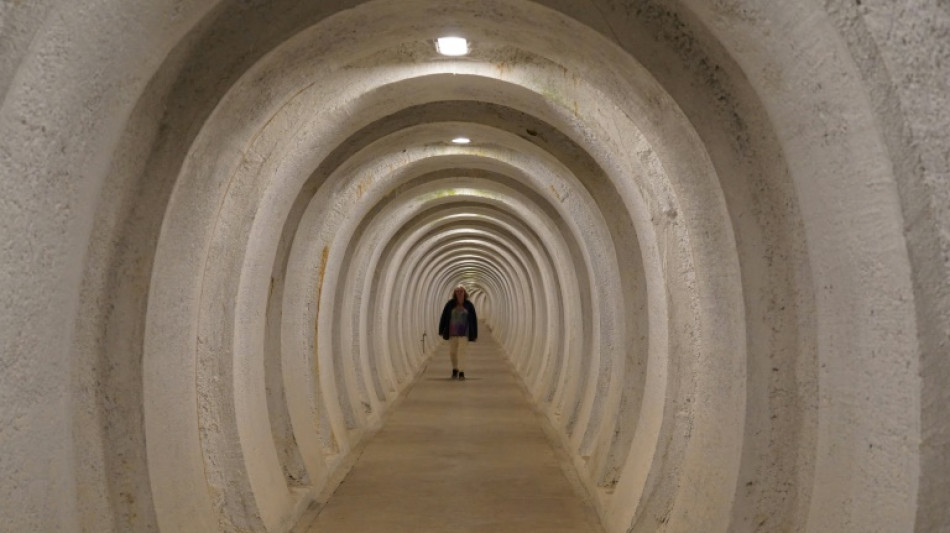
Cold War fears revisited in Danish nuclear bunker / Photo: James BROOKS - AFP

 US fight off spirited France to win 12th World Cup

 Drivers give cool reception to new Madring circuit

 Maresca makes flawless Man City start to leave Man Utd trailing

 Dozens arrested in major anti-LGBTQ raids in Turkey

 Leftwing opposition seen leading Sweden election, far-right losing ground
 Senegal goalkeeper Mendy retires from international football

 Carrick 'worried' by decision to award Man City winner

 Lobotka eases pressure on Allegri with Napoli winner
 Trump watches as Lowry wins Irish Open in record-breaking style

 Poland, Ukraine slam Russian strikes near border as 'escalation'
 Haaland fires 10-man Man City to memorable win over Man Utd
 I miss the adrenaline, but it's not my moment - Bolt

 Championship leader Antonelli to 'keep pushing' for title
 Yamal double helps Barca edge Levante thriller

 Brighton run rampant against 10-man Coventry
 Late Mbappe goal sends Lille top of Ligue 1

 Five-star Brighton crush 10-man Coventry
 Team Europe beat United States to reclaim Solheim Cup

 US House Speaker warns curbing AI too sharply could leave China ahead

 張國榮70歲誕辰音樂會西九舉行 唐鶴德錄音致意

 Iran's economic ties to Dubai hard to break despite war

 iPhone 18預購後出現可疑扣款 四間銀行調查未授權交易
 《浪花男女》辦特別謝票場 馮志強談票房與導演客串拍攝

 Former captain De Villiers hails 'fantastic' Springboks

 Galaxy Tab S12系列效果圖曝光 Ultra擬配雙鏡頭及瀏海螢幕
Hidden deep in northern Denmark's Rold Forest, a sprawling top secret nuclear bunker is opening to the public for the first time, shedding light on daily life during the Cold War.
The underground shelter, where everything is still intact as in a time capsule, becomes a museum from Monday, amid revived fears in Europe of a nuclear conflict following Russia's invasion of Ukraine.
The bunker was built between 1963 and 1968 at NATO's insistence, following Soviet nuclear tests and the Cuban Missile Crisis.
Dubbed "Regan West", it was designed to house the Danish government and the sitting monarch in the event of nuclear war.
Nestled beneath trees, 60 metres (200 feet) under a chalk hill, it was meant to be "the last bastion" of democracy in Denmark, museum director Lars Christian Norbach told AFP.
Located almost 400 kilometres (250 miles) northwest of Copenhagen, the bunker was set up to house Danish authorities for 30 days.
"The H-bomb totally altered the situation about how you could react to a nuclear attack", museum curator and historian Bodil Frandsen told AFP.
"The bunkers you already had could in no way withstand the blast from that. So you had to do something new", she said.
The survival of the government in the event of a nuclear disaster was essential to the nation's sovereignty, she noted.
"As long as you could have a government here that could claim control of at least some part of the country, and you have a government still rooted in Denmark, then Denmark, as a sovereign democratic state, was still alive", Frandsen explained.
- ' Time capsule' -
Never used, the bunker was taken out of service in 2003 and first revealed to the world in 2012.
Walking through the long, arched corridors, visitors see the basic bedroom intended for the monarch, the cafeteria, the government conference room and 60s-style decor in a dimly-lit lounge.
"It's a time capsule of papers, pencils, everything is where it was left", Norbach said.
An exhibit also outlines the main events during the period, with everyday objects on display.
Museum visitors will walk two kilometres (1.2 miles) during the 90-minute tour, and still only see about 40 percent of it.
"This is a very important place in terms of showing younger people... how anxious people actually were during the Cold War," Frandsen said.
And now, heightened tensions between Russia and the West have made the topic all-too relevant again.
"The Cold War has gained actuality again, and that's what we are saying in the museum", Norbach added.
A.Williams--AT