Rescuers race to find Turkey-Syria quake survivors as toll tops 21,000 / Photo: Bakr ALKASEM - AFP

 US fight off spirited France to win 12th World Cup

 Drivers give cool reception to new Madring circuit

 Maresca makes flawless Man City start to leave Man Utd trailing

 Dozens arrested in major anti-LGBTQ raids in Turkey

 Leftwing opposition seen leading Sweden election, far-right losing ground

 Senegal goalkeeper Mendy retires from international football

 Carrick 'worried' by decision to award Man City winner

 Lobotka eases pressure on Allegri with Napoli winner

 Trump watches as Lowry wins Irish Open in record-breaking style

 Poland, Ukraine slam Russian strikes near border as 'escalation'

 Haaland fires 10-man Man City to memorable win over Man Utd

 I miss the adrenaline, but it's not my moment - Bolt

 Championship leader Antonelli to 'keep pushing' for title

 Yamal double helps Barca edge Levante thriller

 Brighton run rampant against 10-man Coventry

 Late Mbappe goal sends Lille top of Ligue 1

 Five-star Brighton crush 10-man Coventry

 Team Europe beat United States to reclaim Solheim Cup

 US House Speaker warns curbing AI too sharply could leave China ahead

 張國榮70歲誕辰音樂會西九舉行 唐鶴德錄音致意

 Iran's economic ties to Dubai hard to break despite war

 iPhone 18預購後出現可疑扣款 四間銀行調查未授權交易
 《浪花男女》辦特別謝票場 馮志強談票房與導演客串拍攝

 Former captain De Villiers hails 'fantastic' Springboks

 Galaxy Tab S12系列效果圖曝光 Ultra擬配雙鏡頭及瀏海螢幕

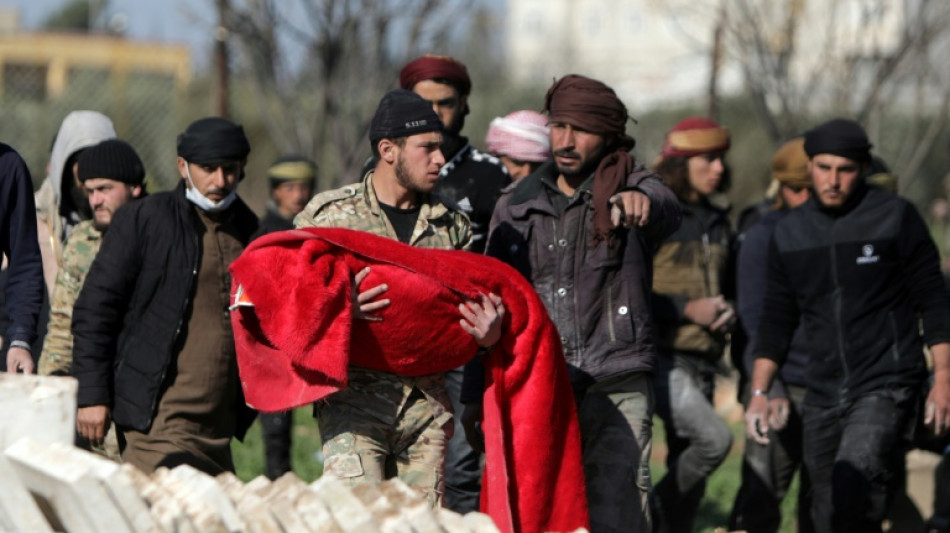
Rescuers were scouring debris on Friday nearly 100 hours after a massive earthquake hit Turkey and Syria, killing at least 21,000 people in one of the region's worst disasters for a century.
The first UN aid deliveries arrived on Thursday in Syrian rebel-held zones, but chances of finding survivors have dimmed since the passing of the three-day mark that experts consider a critical period to save lives.
Bitter cold hampered search efforts in both countries, but more than 80 hours after the disaster struck, 16-year-old Melda Adtas was found alive in the southern Turkish city of Antakya.
Her overjoyed father was in tears and the grieving nation cheered an agonisingly rare piece of good news.
"My dear, my dear!" he called out as rescuers pulled the teen out of the rubble and the watching crowd broke into applause.
The 7.8-magnitude quake struck early Monday as people slept, in a region where many had already suffered loss and displacement due to Syria's civil war.
Top aid officials were planning to visit affected areas with World Health Organization head Tedros Adhanom Ghebreyesus and UN humanitarian chief Martin Griffiths both announcing trips.
The president of the International Committee of the Red Cross, Mirjana Spoljaric, said she had arrived in Aleppo.
"Communities struggling after years of fierce fighting are now crippled by the earthquake," Spoljaric tweeted on Wednesday.
"As this tragic event unfolds, people's desperate plight must be addressed."
- Aid reaches rebel areas -
An aid convoy crossed the Turkish border into rebel-held northwestern Syria on Thursday, the first delivery into the area since the quake, an official at the Bab al-Hawa crossing told AFP.
The crossing is the only way UN assistance can reach civilians without going through areas controlled by Syrian government forces.
A decade of civil war and Syrian-Russian aerial bombardment had already destroyed hospitals, collapsed the economy and prompted electricity, fuel and water shortages.
UN Secretary-General Antonio Guterres urged the Security Council to authorise the opening of new cross-border humanitarian aid points between Turkey and Syria.
Four million people living in the rebel-held areas have had to rely on the Bab al-Hawa crossing as part of an aid operation authorised by the UN Security Council nearly a decade ago.
"This is the moment of unity, it's not a moment to politicise or to divide but it is obvious that we need massive support," Guterres said.
- Freezing temperatures -
Temperatures in the Turkish city of Gaziantep, located near the epicentre of the quake, plunged to minus three degrees Celsius (26 degrees Fahrenheit) early on Friday.
Despite the cold, thousands of families had to spend the night in cars and makeshift tents -- too scared or banned from returning to their homes.
Parents walked the streets of the city carrying their children in blankets because it was warmer than sitting in a tent.
Gyms, mosques, schools and some stores have opened at night. But beds are scarce and thousands spend the nights in cars with engines running to provide heat.
"I fear for anyone who is trapped under the rubble in this," said Melek Halici, who wrapped her two-year-old daughter in a blanket as they watched rescuers working into the night.
- 'The quiet is agonising' -
Monday's quake was the largest Turkey has seen since 1939, when 33,000 people died in the eastern Erzincan province.
Officials and medics said 17,674 people had died in Turkey and 3,377 in Syria from Monday's tremor, bringing the confirmed total to 21,051.
Experts fear the number will continue to rise sharply.
Anger has mounted over the government's handling of the disaster.
"People who didn't die from the earthquake were left to die in the cold," Hakan Tanriverdi told AFP in Adiyaman province, one of the areas hardest hit.
On a visit to the area, Turkish President Recep Tayyip Erdogan admitted there had been "shortcomings" in the government's handling of the disaster.
Despite the difficulties, thousands of local and foreign searchers have not given up the hunt for more survivors.
In the devastated Turkish town of Nurdagi, close to the epicentre, emergency workers using drones and heat detecting monitors ordered silence when a potential survivor was found.
"The quiet is agonising. We just don't know what to expect," Emre, a local resident, said as he waited next to one block on a main road into the town.
- Relief pledges -
Dozens of nations, including China and the United States, have pledged to help.
The World Bank said it would give $1.78 billion in aid to Turkey to help relief and recovery efforts.
Immediate assistance of $780 million will be offered from two existing projects in Turkey, said the bank, while an added $1 billion in operations is being prepared to support affected people.
In addition to a staggering human toll, the quake's economic cost appears likely to exceed $2 billion and could reach $4 billion or more, Fitch Ratings said.
T.Wright--AT