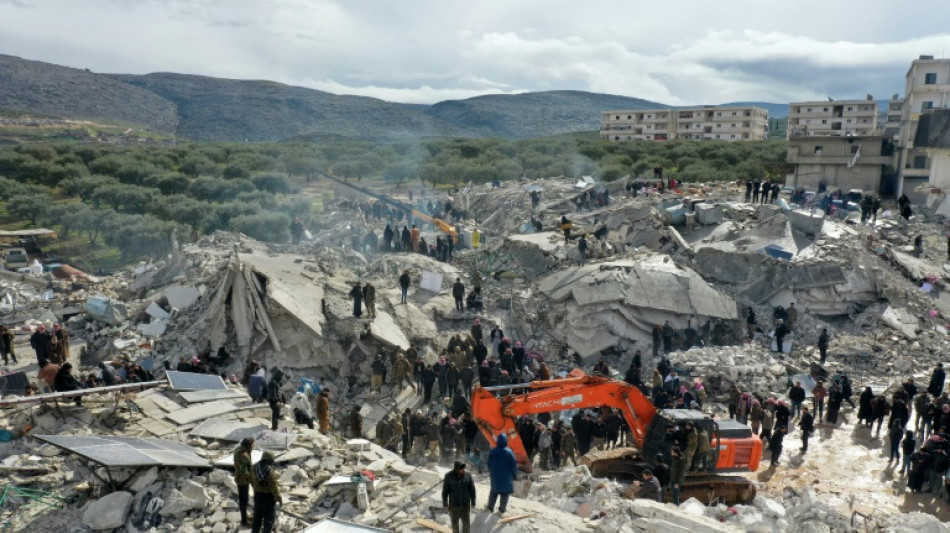
Why was the Turkey-Syria earthquake so deadly? / Photo: Omar HAJ KADOUR - AFP

 US fight off spirited France to win 12th World Cup

 Drivers give cool reception to new Madring circuit

 Maresca makes flawless Man City start to leave Man Utd trailing

 Dozens arrested in major anti-LGBTQ raids in Turkey

 Leftwing opposition seen leading Sweden election, far-right losing ground

 Senegal goalkeeper Mendy retires from international football

 Carrick 'worried' by decision to award Man City winner

 Lobotka eases pressure on Allegri with Napoli winner

 Trump watches as Lowry wins Irish Open in record-breaking style

 Poland, Ukraine slam Russian strikes near border as 'escalation'

 Haaland fires 10-man Man City to memorable win over Man Utd

 I miss the adrenaline, but it's not my moment - Bolt

 Championship leader Antonelli to 'keep pushing' for title

 Yamal double helps Barca edge Levante thriller

 Brighton run rampant against 10-man Coventry

 Late Mbappe goal sends Lille top of Ligue 1

 Five-star Brighton crush 10-man Coventry

 Team Europe beat United States to reclaim Solheim Cup

 US House Speaker warns curbing AI too sharply could leave China ahead

 張國榮70歲誕辰音樂會西九舉行 唐鶴德錄音致意

 Iran's economic ties to Dubai hard to break despite war

 iPhone 18預購後出現可疑扣款 四間銀行調查未授權交易

 《浪花男女》辦特別謝票場 馮志強談票房與導演客串拍攝

 Former captain De Villiers hails 'fantastic' Springboks

 Galaxy Tab S12系列效果圖曝光 Ultra擬配雙鏡頭及瀏海螢幕

A combination of factors made the powerful earthquake that struck Turkey and Syria early Monday particularly deadly, including its timing, location, relatively quiet fault line and the weak construction of the collapsed buildings, experts said.
More than 2,300 people have been killed by the 7.8-magnitude quake near Turkey's Syrian border, with the toll expected to grow as aftershocks reverberate throughout the day.
The earthquake caused such devastation partly because of its power -- it is the strongest earthquake to hit Turkey since 1939 -- and because it hit a populated region.
Another reason is that it occurred at 04:17 am (0117 GMT), which meant that sleeping people were "trapped when their houses collapsed," Roger Musson, honorary research associate at the British Geological Survey, told AFP.
The construction of buildings was also not "really adequate for an area that's susceptible to large earthquakes," said the author of the book "The Million Death Quake".
That could partly be due to the fact that the fault line on which the earthquake struck has been relatively quiet recently.
Turkey is in one of the world's most active earthquake zones. A quake along the North Anatolian fault line in the northern Turkish region of Duzce killed more than 17,000 people in 1999.
But Monday's earthquake occurred on the other side of the country, along the East Anatolian fault.
The East Anatolian fault has not had a magnitude-7 quake for over two centuries, which could mean people were "neglecting how dangerous" it is, Musson said.
Because it had been so long since the last big quake, "quite a lot of energy" may have built up, Musson theorised.
The strength of the aftershocks on Monday, including a huge 7.5-magnitude tremor, supported this theory, he added.
- 'Rerun' of 1822 -
This earthquake was "almost a rerun" of a 7.4 magnitude one in the same area on August 13, 1822, Musson said.
It caused "an enormous amount of damage, whole towns in ruins, and casualties in the tens of thousands," he said.
Aftershocks from that quake continued to rumble until June the following year.
The epicentre of Monday's earthquake was at a relatively shallow depth of about 17.9 kilometres (11 miles) near the Turkish city of Gaziantep, which is home to around two million people.
It was caused by the Arabian tectonic plate moving northward, "scraping past Turkey," Musson said.
"Because it cannot move smoothly, it sticks," he said.
"The release of that movement along the fault is what produces a major earthquake like the one we've had today."
Musson emphasised that the epicentre of such an earthquake was less important than how far the rupture extended along the fault line -- in this case, around 100 kilometres (62 miles).
"This means that anywhere within the 100 kilometres along the trend of the fault is effectively right on top of the earthquake," he said.
- 'Patchy' infrastructure -
Carmen Solana, a volcanologist at the UK's Portsmouth University, said that because earthquakes cannot be predicted, tremor-resistant buildings were crucial in affected areas.
"The resistant infrastructure is unfortunately patchy in South Turkey and especially Syria, so saving lives now mostly relies" on efforts to rescue survivors, she added.
In response to the 1999 earthquake, Turkey's government passed legislation in 2004 mandating that all new construction met modern earthquake-proof standards.
Turkish President Recep Tayyip Erdogan made strong construction into a political priority after another quake struck the Aegean coast in 2020, killing 114 people.
Joanna Faure Walker, head of the University College London's Institute for Risk and Disaster Reduction, called for Turkey to check whether the legislation had been adhered to in light of the latest disaster.
Bill McGuire, a volcanologist at University College London, said that "in Syria many structures have already been weakened by more than a decade of war".
A.O.Scott--AT