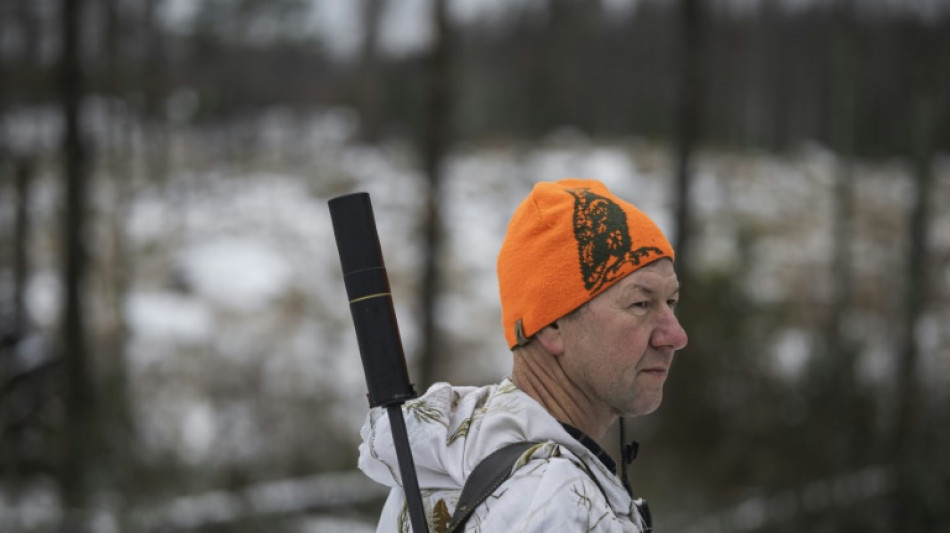
Emotions run high in Sweden's biggest wolf hunt / Photo: Jonathan NACKSTRAND - AFP

 Swedish left-wing cheers far-right decline amid tight election race

 Yamal double helps Barca beat Levante, Atletico triumph

 Sassuolo stun Juve, Lobotka eases pressure on Allegri with Napoli winner

 Bills beat Texans and Ravens roll Colts in NFL openers

 US fight off spirited France to win 12th World Cup

 Drivers give cool reception to new Madring circuit

 Maresca makes flawless Man City start to leave Man Utd trailing

 Dozens arrested in major anti-LGBTQ raids in Turkey

 Leftwing opposition seen leading Sweden election, far-right losing ground

 Senegal goalkeeper Mendy retires from international football

 Carrick 'worried' by decision to award Man City winner

 Lobotka eases pressure on Allegri with Napoli winner

 Trump watches as Lowry wins Irish Open in record-breaking style

 Poland, Ukraine slam Russian strikes near border as 'escalation'

 Haaland fires 10-man Man City to memorable win over Man Utd

 I miss the adrenaline, but it's not my moment - Bolt

 Championship leader Antonelli to 'keep pushing' for title

 Yamal double helps Barca edge Levante thriller

 Brighton run rampant against 10-man Coventry

 Late Mbappe goal sends Lille top of Ligue 1

 Five-star Brighton crush 10-man Coventry

 Team Europe beat United States to reclaim Solheim Cup

 US House Speaker warns curbing AI too sharply could leave China ahead

 張國榮70歲誕辰音樂會西九舉行 唐鶴德錄音致意

 Iran's economic ties to Dubai hard to break despite war

Hunter Lars Bjork points to fresh tracks in the snow as he lumbers through a whited-out forest in central Sweden, where the biggest wolf hunt in modern times is drawing controversy.
"We have quite a lot of wolves here, we're actually sitting in a new wolf territory where we are now," Bjork, a predator expert at the Swedish Hunters' Association, tells AFP as he settles into a small hunting lodge a few kilometres (miles) outside the town of Vasteras.
Long known as a champion of environmental protection, Sweden has paradoxically had a centuries-long opposition to wolves, considered a plague in the 1800s with the state paying out bounties for kills as late as the mid-20th century.
Still seen as a threat by farmers, the state now sanctions a limited cull of the animals every year.
This year, Sweden's hunters are allowed to kill a record 75 wolves out of an estimated population of 460, according to the Swedish Environmental Protection Agency's latest inventory.
That is more than twice the number that hunters were allowed to kill last year, and the highest number since the culls began in 2010.
A total of 54 wolves had been killed as of Sunday.
Several local authorities have already called off the hunt in their regions, and the full quota isn't expected to be reached by the February 15 deadline.
Nonetheless, the wolf hunt remains a highly divisive issue, both inside and outside the Nordic nation.
- Rural problems -
After Sweden's wolves were hunted to the brink of extinction, the country declared them a protected species in the 1960s.
Wolves started reappearing in the late 1970s and 1980s, before populations started growing in the 1990s.
As their numbers surpassed 200, Sweden began allowing licensed hunts in 2010, issuing quotas for the number that can be killed during a set period.
"The purpose is simply to limit the problems they cause out in more rural areas," 59-year-old Bjork explains.
For farmers, wolves are a menace as they occasionally attack livestock, primarily sheep.
They also pose a threat to hunting dogs, used to track and drive wild game such as deer and elk.
Sweden also allows yearly hunts of brown bears, wolverines and lynx -- all considered endangered -- in order to limit damage to livestock and reindeer.
Reindeer are integral to the indigenous Sami people's way of life in the far north.
All hunts have detractors, but the wolf hunt has been particularly acrimonious since its inception.
Opponents of the hunt argue wolves are needed to protect biodiversity, playing an important role as predators.
"It is astonishing that Sweden keeps on making these decisions," says Marie Stegard Lind, vice president of Jaktkritikerna, a group working to limit hunting.
The hunts continue "in spite of the fact that the European Commission has been very clear about its opinion that these hunts are in fact illegal", she tells AFP at the group's office in Stockholm.
In 2015, the European Commission warned that Sweden's wolf hunt fell foul of the EU's Habitats Directive, noting that the wolf "population has not reached a level that guarantees the conservation of the species".
Other EU members with growing wolf populations have called on the Commission to update its Habitats Directive to better protect livestock farming.
- Question of numbers -
Kjell-Arne Ottosson, a Swedish member of parliament for the Christian Democrats and vice president of the environment and agriculture committee, tells AFP that Sweden needs to stand its ground against the EU.
"Wolves are a threat for those of us who live in rural areas. We have to manage that, we have to take this seriously," Ottoson says.
The only fatal wolf attack in modern times against a person in Sweden was in 2012, when a captive wolf attacked a keeper at the Kolmarden Wildlife Park.
But the issue often boils down to disputes over an acceptable size for the wolf population in terms of impact and risks, and ensuring there are enough wolves to limit inbreeding.
According to the Swedish Environmental Protection Agency, at least 300 are necessary to sustain a healthy population.
In a letter published by magazine Science in July 2022, a group of scientists argued the culls were a threat to a healthy Swedish wolf population.
They said the stocks that span Scandinavia and Finland should be kept above 500.
Conversely, Sweden's parliament in 2021 voted to cap the population at 270 wolves.
The Swedish Hunters' Association wants to go even further and lower the limit to 150 wolves, spread across the country.
Currently the animals are mostly found in the central and western parts of Sweden.
"The wolf has a place here, absolutely," hunter Bjork says.
"But not in the amounts we have today and not in the concentrations we have today."
E.Hall--AT