Sweden battles disinformation on 'kidnappings' of Muslim children

 Alcaraz wins Japan Open for first title since injury return

 'We're working to keep football clean', Turkish minister says

 FIFA chief Infantino hit by Norwegian double complaint

 Exiled Catalan separatist leader Puigdemont cleared to return to Spain

 Stock markets climb as oil prices retreat

 'No future': Thousands mass in France for high school protests
 Nobel physics prize honours work on 'ghostly messengers' from outer space

 Bulgaria searches for missing crew after drones hit two more ships in Black Sea
 Le Pen vows drastic cost savings to prevent French 'default'

 'Eats through a straw': French teens wounded in high school protests

 Thousands mass in France for high school protests

 Moscow denies sanitary measures over plague reports
 Samoa look to recreate 2022 final run at Rugby League World Cup

 Asian stocks mostly up after tech-led Wall St record

 German factory orders plunge as recovery still fragile
 Coco Gauff calls out online racism following China open video review

 KVB Accelerates Middle East Footprint with Strategic MENA Regional Expansion
 Purple reign: Philippines seeks to keep grip on ube throne
 Seoul weighs steps to force North Korea landmine apology

 Yemen's Houthis say struck Riyadh airport, other Saudi sites

 Changer+ Launches Stablecoin-First Self-Custodial Wallet to Make Stablecoins Easier to Use

 White Sox down Guardians, Yankees on brink after Rays loss

 COP31 eyes modest steps as climate disasters multiply

 American Nobel laureate in medicine hopes to illuminate the brain

 Trump approves firing squad for convicted US military base shooter

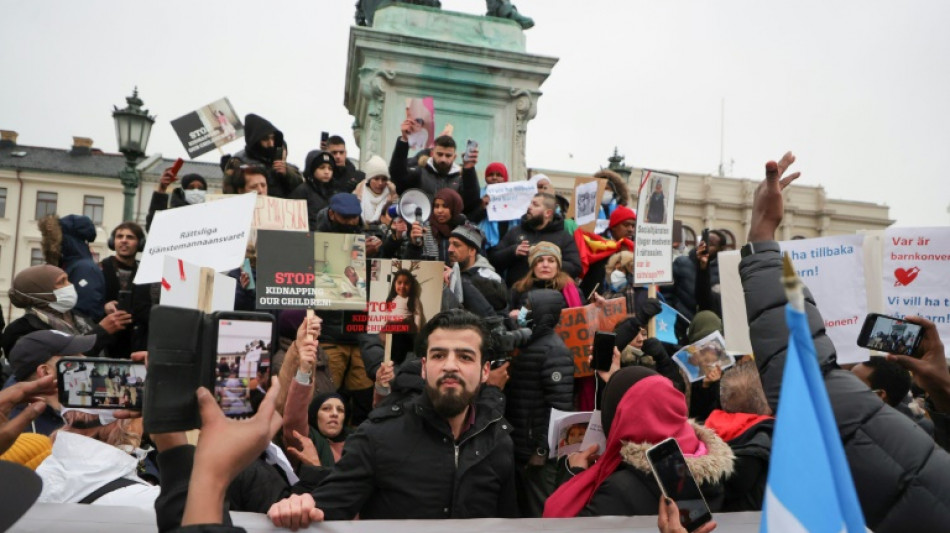
Swedish authorities are fighting back against claims its social services are "kidnapping" Muslim children, denouncing a "disinformation campaign" of viral videos spreading mistrust among immigrant families.
Videos began appearing on Arabic-language social media sites in late 2021 of real interventions by child welfare services, showing crying children being separated from distraught parents.
With limited context about the situations portrayed, the videos accuse Sweden of being a fascist state where social services place Muslim children in Christian homes with paedophiles or where they are forced to drink alcohol and eat pork.
After Mideastern media outlets reported on the claims, Swedish government officials and social services have come out in force to deny the allegations.
"We absolutely do not do that," Migration and Integration Minister Anders Ygeman told AFP, stressing the main goal was to support families.
Ygeman said the campaign was being fuelled in part by "frustrated parents who have failed in their parenting" and were projecting their anger at authorities.
- 'Malevolent forces' -
"There are also malevolent forces that want to exploit these parents' frustration to spread mistrust and division," he said.
Sweden's newly created Psychological Defence Agency has described many of the videos as old, presenting a false context with a "purpose to polarise".
Magnus Ranstorp, a terrorism expert at the Swedish Defence University, told AFP the campaign was primarily based on a Facebook group called "Barnens Rattigheter Mina Rattigheter" (Children's Rights My Rights), where parents share experiences of having their children "unfairly" removed from their care.
Radical imams in Sweden and abroad picked up on the stories, as did a new fringe political party Nyans (Nuance), which has made the forced removal of children a rallying cry ahead of the general election in September.
Muslim online influencers with millions of followers also joined the fray, as well as Arabic site "Shuoun Islamiya" ("Islamic Affairs"), which has published around 20 videos.
Several protests have also been held across Sweden.
Ranstorp said that while there may be some legitimate criticism against social services, the harsh rhetoric in the media posts was "inciting".
Julia Agha, head of the Arabic-language news outlet Alkompis based in Stockholm, has followed the campaign closely.
"Starting out, it was probably intended as a campaign where families of those whose children have been taken into custody have felt unjustly treated and wanted to criticise social services," she told AFP.
"What's happened is that this campaign has ended up in the hands of forces abroad that have put a religious filter over it and are spreading disinformation, which now looks more like a hate campaign against Sweden and Swedish society."
- 'Integration challenges' -
Sweden's National Board of Health and Welfare, which oversees social services, insists that removing children from their homes is always a last resort.
It is only done "when voluntary measures are not possible and there is a considerable risk that the child's health or development is harmed", the agency told AFP in an email.
In 2020, a total of 9,034 children were in state-ordered care without their parents' consent, official statistics show.
Researchers and social workers have noted that while more immigrant children are removed from their homes than ethnic Swedes, immigrant families are also less likely to accept earlier stages of assistance from social workers.
Sweden is often hailed as a pioneer in children's rights and was the first country to ban corporal punishment of children, including spankings, in 1966.
But critics say that dismissing the issue as disinformation ignores real issues with social services.
Mariya Ellmoutaouakkil, 35, who immigrated to Sweden 12 years ago from Morocco, organised a protest outside the social services office in her hometown of Gallivare last year, after two of her three children were removed from her care.
She told AFP her son, aged 10, and daughter, six, were taken after social services alleged violence in the home.
She said the decision was not based on evidence, only on social workers' interviews with the children that she has never been allowed to see.
Social services typically do not comment on individual cases.
Ellmoutaouakkil said she understood her children had not been "kidnapped", but did understand why some people use the term.
"It can start to feel like a kidnapping for me as a mother," she said. "When we as parents don't get answers, I can understand that they call it that".
Sweden has struggled for years to integrate immigrants.
The wealthy country of 10.4 million granted asylum and family reunifications to more than 400,000 people from 2010 to 2019 -- more per capita than any other European country.
"Sweden still has many integration challenges, not least when it comes to segregation," Agha told AFP.
She said many immigrants struggle to learn Swedish, live in areas where they only interact with other immigrants, and don't feel a part of Swedish society.
A.Ruiz--AT