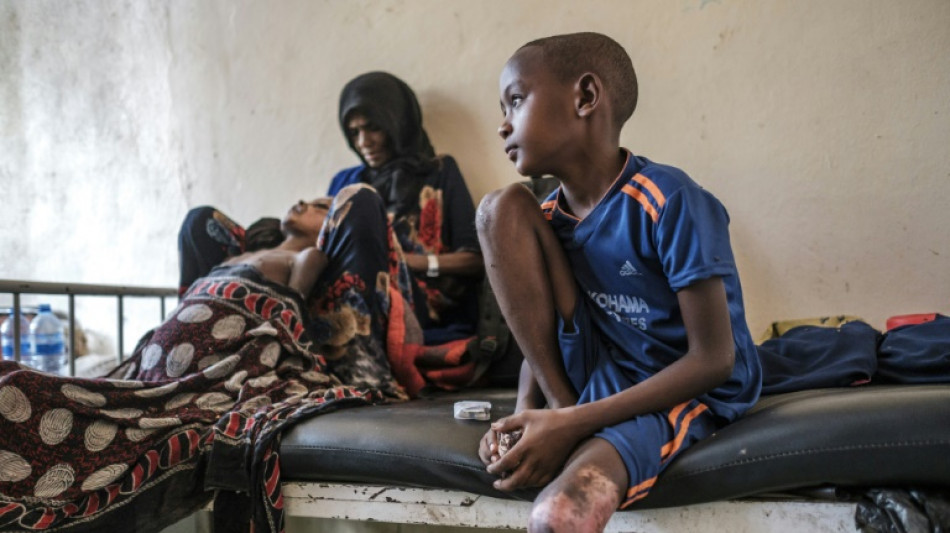
'Afar has been raided': Suffering stalks Ethiopia's forgotten front

 Muchova squeaks out win over Osaka to reach China Open quarter-finals

 Kenya reports first-ever Ebola death

 Tennis world No.1 Sinner's season over due to knee injury
 Yemen's Houthis claim attack on Riyadh airport, deny losing territory

 7-Eleven exits India amid mounting competition

 The alleged murder by US marine on Okinawa: five things to know

 End of an era as Messi prepares to hang up Argentina boots

 Superstar duo headline strong New Zealand squad for Rugby League World Cup

 South Korea warns of possible AI use in banking hacks

 EU vows AI rules will protect Europeans. Will they?

 Myanmar leader to visit Malaysia after migrant returns begin
 Germany's AfD poised to preside over state assembly for first time
 Australia's opposition vows 'largest cut to immigration' in country's history
 Ready, set, snooze: Sleep-deprived Japanese compete for best-rested

 Falcons thump Saints 45-24 as New Orleans marks Katrina anniversary

 Tuvalu govt adviser says Australia overstepped in pre-COP visit

 Asian stocks mixed despite tech-led Wall St record

 Tens of thousands expected in Paris for high school protests

 AI borrowing binge rattles US markets

 Young Canadians sue government over alleged climate failures

 White Sox down Guardians to take 2-0 series lead

 CPG Industry Veteran Sandro Piancone Featured Guest on "Straight Talk with DJ Doc" Podcast Discusses New Book Wholesale MBA and the Future of Consumer Packaged Goods

 Pineapple Express Strain Guide Compares Conflicting Lineage Records and Historical Lab Data

 InterContinental Hotels Group PLC Announces Transaction in Own Shares - October 06

 Leaders visit Pacific atoll at frontline of climate change

The shell crashed through Aicha Nur's flimsy hut just as she was serving a lunch of bread and milk to her nine-year-old son Tahir.
His slim body quickly became engulfed in flames.
She grabbed Tahir and another son before fleeing on foot to safety, dodging an artillery assault allegedly carried out by Tigrayan rebels on her village in northern Ethiopia's Afar region.
They managed to escape, but Aicha's six other children remain unaccounted for.
She worries she has lost them forever to what has quietly emerged as the most active front in Ethiopia's grinding war.
More than 15 months since the first shots rang out, foreign envoys are talking up paths to peace for Ethiopia and Prime Minister Abiy Ahmed publicly refers to the conflict in the past tense.
But Afar is enduring its roughest period yet, sparked by a fresh rebel offensive that has yielded massive destruction and displacement, according to officials and residents.
Across the arid, punishingly hot region, shell-shocked survivors await food handouts at schools that have been transformed into makeshift displacement sites.
Afar's only referral hospital is stretched well beyond its bed capacity, with doctors running low on anaesthesia amid a seemingly endless influx of civilians with fractured limbs.
All the while, patients wonder aloud why no one seems to be paying attention, complaining that "their voices haven't been heard", said hospital CEO Hussein Aden.
"We've been dying for a long time now, but nobody has listened to us," Aicha told AFP as she propped Tahir up on his hospital bed, fanning away flies from his burned and blistered face.
- Outgunned -
The war erupted in Ethiopia's northernmost Tigray region in November 2020, but Afar did not see combat until July 2021 when the Tigray People's Liberation Front (TPLF) rebel group expanded its operations.
Late last year, fighting intensified in Afar before Abiy, winner of the 2019 Nobel Peace Prize, deployed to the region as part of a counter-offensive that ultimately pushed the rebels back into Tigray.
Those bouts of hostilities pale in comparison to what Afar residents say has unfolded in recent weeks: unremitting attacks involving many more Tigrayan fighters and much heavier weapons, including tanks and automated cannons.
Afar forces, armed with Kalashnikov rifles and lacking military backing, have been thoroughly outgunned.
"You can't defeat mortars with a Kalashnikov," said Ibrahim Abdala, a militia fighter who was shot in the chest in Afar's Kuneba district this month.
- 'Not even a rug to sleep on' -
Afar civilians fleeing the latest attacks describe harrowing, days-long journeys on foot towards towns that are more secure but woefully ill-equipped to feed and shelter them.
Regional government documents seen by AFP indicate 294,000 people were displaced in January, and a regional spokesman said the number is now up to 350,000 since the start of the year.
It's unclear when or even if they will be able to return home, with Afar's western border reportedly occupied by the TPLF.
"All the schools, clinics, hospitals that were constructed in this space of time are now gone on the western border. The whole lot," said Valerie Browning, an aid worker who has lived in Afar for more than three decades.
"Afar has been raided, vandalised, and there is not that much left."
Her claims could not be independently verified.
On a recent afternoon, scores of women and children sat in a sweltering dried-out riverbed, clustered under shade provided by acacia trees and sharing food handouts as boys struggled to play football using a plastic water bottle.
"You see the truth with your own eyes. We have been evicted from our homes and are eating biscuits," said Mohammad Adem Endrisi, a 32-year-old schoolteacher from Kuneba.
"There are pregnant women among us... There is not even a rug to sleep on here."
- 'Path of destruction' -
Aid workers are also worried about sky-high malnutrition rates in Tigray.
The UN says recent fighting has made it impossible for humanitarian convoys to enter Tigray via the Afar capital Semera -- currently the only functioning overland route.
The TPLF has defended its push into Afar, saying it was provoked by attacks on its positions within Tigray and claiming it "does not have a plan to remain in Afar for long."
It also points out that Tigray has been under what the UN terms a "de facto humanitarian blockade" since long before the latest clashes erupted in Afar, while maintaining that its fighters have never prevented aid trucks from passing.
But that argument does not resonate with Afar residents.
"The TPLF has chosen the path of destruction, not the path of peace," said Ahmed Nuro, a local official in the border town of Abala.
"They will never stop firing."
N.Walker--AT