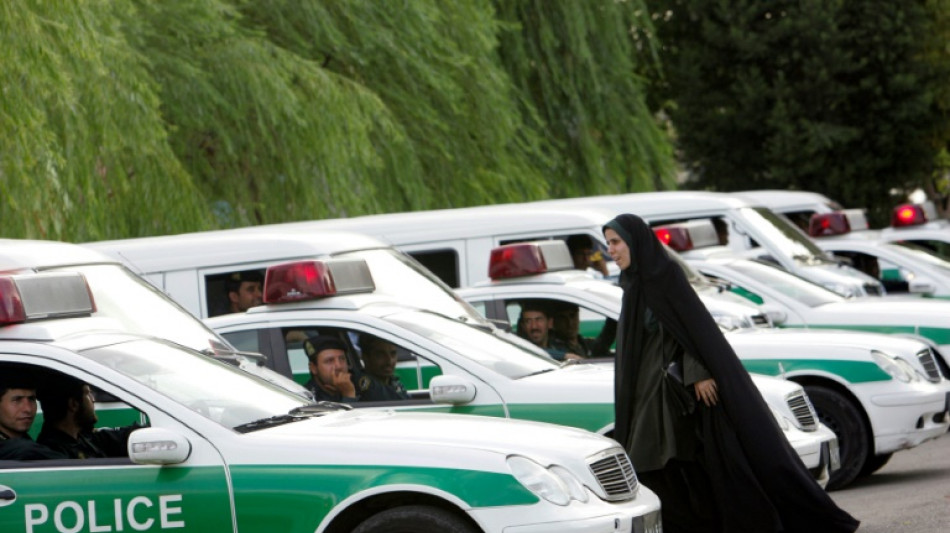
Iran activists brush off claim morality police abolished / Photo: Behrouz MEHRI - AFP/File

 BingX Evolves into a Multi-Asset Trading Platform, Connecting Users to Global Opportunities

 Flick supporting 'self-confident' Yamal Ballon d'Or bid

 As Ballon d'Or vote nears, stars campaign for the award

 Markets on edge as US Fed meets to tackle high inflation

 International Trading Institute Expands Professional Trader Development Beyond the Master’s in Trading

 Nairobi to host 2029 world athletics championships in African first
 Ukraine winemakers defy war to make a splash at home

 Prominent Greek neo-Nazi exits prison, vows return to politics: AFP

 Saudi Arabia vows to respond 'firmly' to Houthi attacks

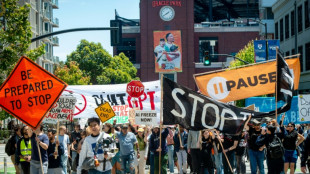 'We unleashed the beast': the world's fears and hopes about AI

 Carragher sees Manchester City’s winning start as challenge to Arsenal

 Oasis fans weigh ticket costs and reunion memories ahead of 2027 tour

 EastEnders previews Kat’s grief after Zoe’s death

 US military confirms Iran war has led to munitions shortfall

 SkySail Strategies Outperforms Wall Street's 30-Year Risk Standard With Proprietary AI Inference Model

 Canada ends refugee family sponsorship exemption over integrity concerns

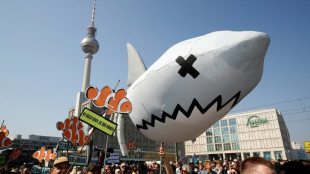 Berlin's run-down public spaces at heart of election campaign

 Ribeiro and Richie among celebrity birthdays for September 20–26

 Bob Mackie, costume designer for Cher and Madonna, dies aged 87
 Mahomes makes triumphant return as Chiefs rout Broncos 31-10
 Belgium completes outer structure of offshore energy island

 Video documents rescue of injured US airman from Iran

 Asian Games: Bigger than Olympics, young stars and a cruise ship

 Asian Games set for liftoff but will have everyone have a bed?

 Most markets drop as oil extends gains ahead of expected US rate hike

Campaigners backing Iran's protest movement on Monday dismissed a claim that the Islamic republic is disbanding its notorious morality police, insisting there was no change to its restrictive dress rules for women.
There were also calls on social media for a three-day strike, more than two months into the wave of civil unrest sparked by the death of Kurdish-Iranian woman Mahsa Amini, 22, after her arrest by the morality police in Tehran.
Amini was accused of flouting Iran's strict dress code demanding women wear modest clothing and the hijab headscarf, and her death sparked protests that have spiralled into the biggest challenge to the regime since the 1979 Islamic revolution.
Iran's Prosecutor General Mohammad Jafar Montazeri, in a surprise move at the weekend, was quoted as saying that the morality police units –- known as gasht-e ershad (guidance patrol) -- had been closed down.
But activists were sceptical about his comments, which appeared to be an impromptu response to a question at a conference rather than a clearly signposted announcement on the morality police, which is run by the interior ministry.
Moreover, they said, their abolition would mark no change to Iran's headscarf policy -- a key ideological pillar for its clerical leadership -- but rather a switch in tactics on enforcing it.
Scrapping the units would be "probably too little too late" for the protesters who now demand outright regime change, Roya Boroumand, co-founder of the US-based Abdorrahman Boroumand Center rights group, told AFP.
"Unless they remove all legal restrictions on women's dress and the laws controlling citizens' private lives, this is just a PR move," she said, adding that "nothing prevents other law enforcement" bodies from policing "the discriminatory laws".
- 'Civil disobedience' -
The guidance patrols have been a familiar sight on Tehran's streets since 2006 when they were introduced during the presidency of the ultra-conservative Mahmoud Ahmadinejad. But the clerical leadership had been strictly enforcing the rules, including the headscarf, well before then.
Under the last shah, Mohammad Reza Pahlavi, women had been free to dress as they wished with fashions little different from Western countries in secular areas of Tehran. His father Reza Shah had gone a step further in an edict issued in 1936, seeking to ban all Islamic veils and headscarves.
It was anger over the obligatory headscarf rule that sparked the first protests over the death of Amini, who died from what her family says was a blow to a head sustained in custody. The authorities dispute this.
But the movement, fed also by years of anger over economic grievances and political repression, is now marked by calls for an end to the Islamic republic led by Ayatollah Ali Khamenei.
Reports from Tehran have suggested the feared vans of the guidance patrols had already become much less common or even vanished after the protests broke out.
Images have also shown women smashing decades-long taboos by attending protests or even carrying out daily tasks like going shopping without headscarves.
- 'Pillar of Islamic republic' -
The authorities have meanwhile been concentrating on battling the protests themselves in a crackdown that has left at least 448 people dead, according to Norway-based group Iran Human Rights.
"The alleged suspension of Iran's morality police doesn't mean anything as it had already become irrelevant due to the massive level of women's civil disobedience and defying hijab-related rules," said Omid Memarian, a senior Iran analyst at Democracy for the Arab World Now.
He described the mandatory headscarf as "one of the pillars of the Islamic republic" and said that "abolishing those laws and structures would mean a fundamental change in the Islamic Republic's identity and existence".
Montazeri's declaration and the confusion the comments sparked were seen as a sign of the disquiet within the regime over how to handle the protests which are continuing across the country despite the crackdown.
Within Iran on Monday there appeared to be hesitancy over the meaning of the comments with only reformist dailies putting the issue on their front page and conservative media largely ignoring it.
"The end of the morality police," read a headline in daily Sazandegi. But the Sharq newspaper was more circumspect. "Is this the end of the patrols?" it asked, noting the police public relations had not confirmed it.
"We should not be fooled by deceptive moves the Islamic Republic employs at times of desperation, as they might come back with other restrictive policies and measures," said Memarian.
The hijab is "still compulsory", said Shadi Sadr, co-founder of the London based group Justice for Iran. While the protests started over the death of Amini, he predicted, "Iranians won't rest until the regime is gone."
O.Gutierrez--AT