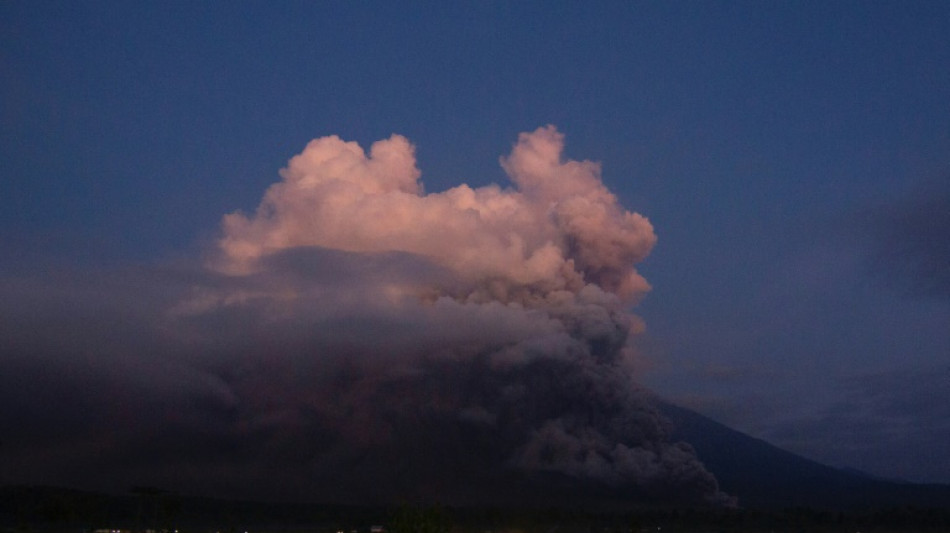
Indonesia's Mount Semeru erupts, forcing thousands to flee / Photo: Agus Harianto - AFP

 Bishop Museum Races to Save Rare Megamouth Shark Specimen

 Zach Hickerson Recounts Hayden Panettiere's Final Moments in New Interview

 Luxembourg Housing Petition Passes Threshold for Parliamentary Consideration

 Raheem Sterling Receives Suspended Sentence After Lamborghini Crash

 Audience to Choose the Set List at Luxembourg's First FAMIL Jukebox Night

 Luxembourg Pay Rise Delayed as Regional and World Headlines Develop

 Chennai Urbanist Sashna Develops 'Anniki' Card Game to Gamify Tamil Nadu History

 Transport Minister Defends Land Seizure Powers for Toronto-Quebec City High-Speed Rail

Indonesia's Mount Semeru erupted Sunday spewing hot ash clouds a mile high and rivers of lava down its side while sparking the evacuation of nearly 2,000 people exactly one year after its last major eruption killed dozens.
The burst from the highest mountain on Indonesia's main island of Java, around 800 kilometres (500 miles) southeast of the capital Jakarta, prompted authorities to raise the alert status for the volcano to the highest level.
Villages around Semeru were being battered by a mix of volcanic ash and monsoon rains. Videos shared with AFP by a local rescue group showed a huge black cloud rising from the volcano, engulfing the sky and blocking the sun.
One resident described the panic when the ash clouds descended on their village.
"It was dark, I could not see anything. It was raining water and ash," the person, who did not want to be named, told AFP.
"I didn't know where to take shelter. I had to flee."
"Hot avalanches" triggered by piles of lava at the top flooded down the 3,676-metre (12,060 feet) mountain, said Abdul Muhari, a spokesperson for Indonesia's National Disaster Mitigation Agency (BNPB).
A spokesperson for Indonesia's Volcanology and Geological Disaster Mitigation Centre (PVMBG) told broadcaster Kompas TV that the higher alert level meant local villages were in danger.
However, no casualties or injuries were reported on Sunday after the PVMBG warned nearby residents not to travel within eight kilometres (five miles) of the crater.
The geological agency said that by evening Semeru was "still in the eruption phase" though the size of the ash clouds was decreasing.
"Overall the activity is still very high," it said in a statement.
The internet in the area was down and phone signals were patchy after the eruption, according to an AFP journalist.
- Rain and ash -
The BNPB said 1,979 people had been taken to 11 shelters, with at least six villages affected by the eruption.
Local administration official Indah Amperawati Masdar said residents would only be allowed to return home when the hot clouds had dissipated.
Residents were also told to avoid a southeastern area 13 kilometres (eight miles) along a river in the direction the ash was travelling.
The majority of residents in the two villages most at risk had been evacuated, said Patria Dwi Hastiadi, a spokesperson for the Lumajang Disaster Mitigation Agency.
Locals fled on motorbikes, some three at a time with their belongings, while others helped the elderly evacuate safely. One resident was covered in mud that had rained down on him as a mix of rain and ash.
Japan's weather agency had earlier warned that a tsunami could be triggered by the eruption affecting southern islands in the country's Okinawa prefecture, Kyodo news agency reported. But Japan's meteorological agency later said no significant tidal changes were observed.
Semeru last erupted exactly one year ago, killing at least 51 people and damaging more than 5,000 homes.
Semeru's alert status had remained at its second-highest level since a previous major eruption in December 2020.
Indonesia sits on the Pacific Ring of Fire, where the meeting of continental plates causes substantial volcanic and seismic activity.
The Southeast Asian archipelago nation has nearly 130 active volcanoes.
H.Gonzales--AT

